 : +1 308-7304-232
 : +44 (744)-139-7094
 : +61 4 8080-3582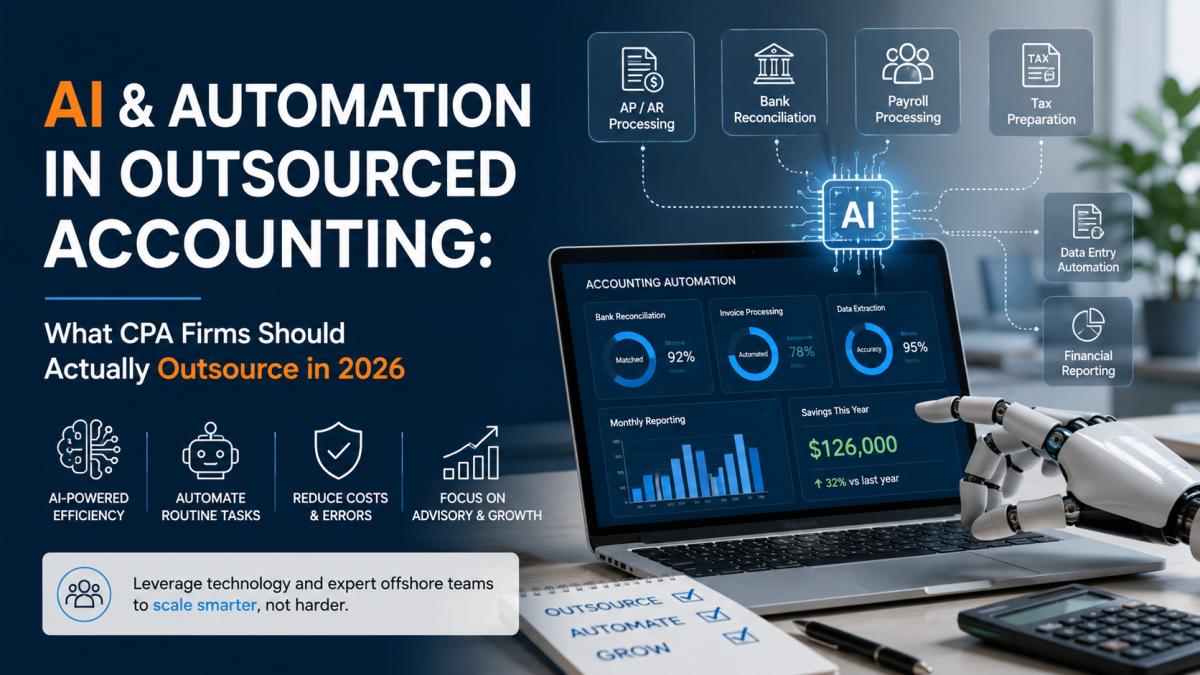
AI & Automation in Outsourced Accounting: What CPA Firms Should Actually Outsource in 2026
For years, "outsourcing" in accounting meant one thing: sending routine, repeatable work — data entry, bank reconciliations, basic bookkeeping — to a lower-cost team offshore. That playbook is changing fast. In 2026, AI has automated a huge chunk of that "routine" work itself, which raises a real question for CPA firm leaders: if software can now categorize transactions and reconcile accounts, what's actually left to outsource — and is it even worth it anymore?
The short answer: yes, outsourcing is more valuable than ever, but what you outsource has shifted. The firms getting real value out of AI in 2026 aren't asking "AI or outsourcing." They're building a stack where AI handles the mechanical work, and outsourced teams handle everything AI still can't — judgment, exceptions, and scale.
AI Hasn't Replaced Outsourcing. It's Redefined It.
There's a popular narrative, often pushed by tech vendors, that AI is making offshore accounting teams obsolete. The data tells a different story. The global finance and accounting outsourcing (FAO) market is projected to exceed $59 billion in 2026 and keep growing at a steady clip through the end of the decade. Firms aren't outsourcing less — they're outsourcing differently.
Tools like Vic.ai and Docyt now handle 80–90% of routine transaction categorization with solid accuracy. What that actually changes is the job description of an outsourced bookkeeper — from "categorize every transaction" to "review what the AI flagged, fix what it got wrong, and handle the judgment calls AI can't make." AI is changing what gets outsourced, not whether outsourcing happens.
What CPA Firms Should Still Outsource in 2026
Here's where outsourcing continues to deliver real ROI, even in an AI-heavy environment:
1. Exception Handling and AI Output Review
AI-generated categorizations, reconciliations, and reports still need a trained human eye — especially for the 10-20% of transactions that don't fit clean patterns. Outsourced teams are increasingly positioned as the "review and exception" layer sitting on top of automated systems, not a replacement for them.
2. Complex, Judgment-Heavy Work
Multi-state tax nexus issues, beneficial ownership reporting, revenue recognition edge cases, and ESG disclosure requirements are growing in complexity. This is exactly the kind of work that benefits from experienced outsourced specialists who understand nuance — something AI still struggles with when the rules aren't black and white.
3. High-Volume, Repetitive-but-Variable Processing
Not every transaction fits a template. Outsourced teams can absorb volume spikes (month-end, tax season, year-end close) without the fixed cost of new hires, while AI handles the truly repetitive slice underneath them.
4. AI System Oversight and "Digital Senior" Roles
A trend worth watching: firms are creating hybrid roles — sometimes called "digital seniors" — who blend accounting expertise with AI workflow oversight and client communication. This role doesn't have to sit onshore. Increasingly, firms are training outsourced staff to fill it, combining cost efficiency with the judgment AI can't replicate.
5. Client Advisory Support (Behind the Scenes)
AI can assemble the numbers, ratios, and draft narratives before a client meeting. But someone still needs to sanity-check the story, tailor it to the client, and prep the advisor delivering it. Outsourced teams are increasingly doing this prep work, freeing up onshore staff for the actual client-facing conversation.
What's Shifting Away From Pure Outsourcing
To be fair, some tasks that used to be default outsourcing candidates are now largely automated end-to-end:
- Basic bank feed categorization and reconciliation
- Routine invoice data entry and matching
- Simple document extraction (receipts, invoices, statements)
These aren't disappearing from the outsourcing conversation entirely — someone still needs to configure, monitor, and occasionally correct these systems — but they no longer justify a large dedicated headcount the way they once did.
The 2026 Model: AI + Outsourcing + Onshore Advisors
The firms scaling successfully in 2026 are converging on a three-layer structure:
- AI/Automation — handles data ingestion, categorization, and first-pass processing
- Outsourced Teams — handle validation, exceptions, complex processing, and volume absorption
- Onshore Advisors — own client relationships, strategic guidance, and final judgment calls
Firms that only invest in AI without rethinking their outsourcing strategy tend to hit a ceiling — they automate the easy 80% but have no scalable plan for the harder 20%. Firms that only outsource without integrating AI end up paying premium rates for work a tool could do for a fraction of the cost. The winners are doing both, deliberately.
The Bottom Line
AI isn't a replacement for outsourced accounting — it's a filter. It's absorbing the mechanical layer of work and pushing outsourced teams up the value chain toward exceptions, complexity, and judgment. For CPA firm leaders, the real 2026 question isn't "should we outsource or automate?" It's "which parts of our workflow still need a trained human, and how do we build outsourced capacity around that?"
Firms that get this balance right aren't just cutting costs — they're building the capacity to scale without proportional headcount growth, which is quickly becoming the real competitive advantage in accounting.
Ready to Scale Your Business?
Connect with our experts to learn how our outsourcing solutions can drive growth.
BOOK A DISCOVERY CALL