 : +1 308-7304-232
 : +44 (744)-139-7094
 : +61 4 8080-3582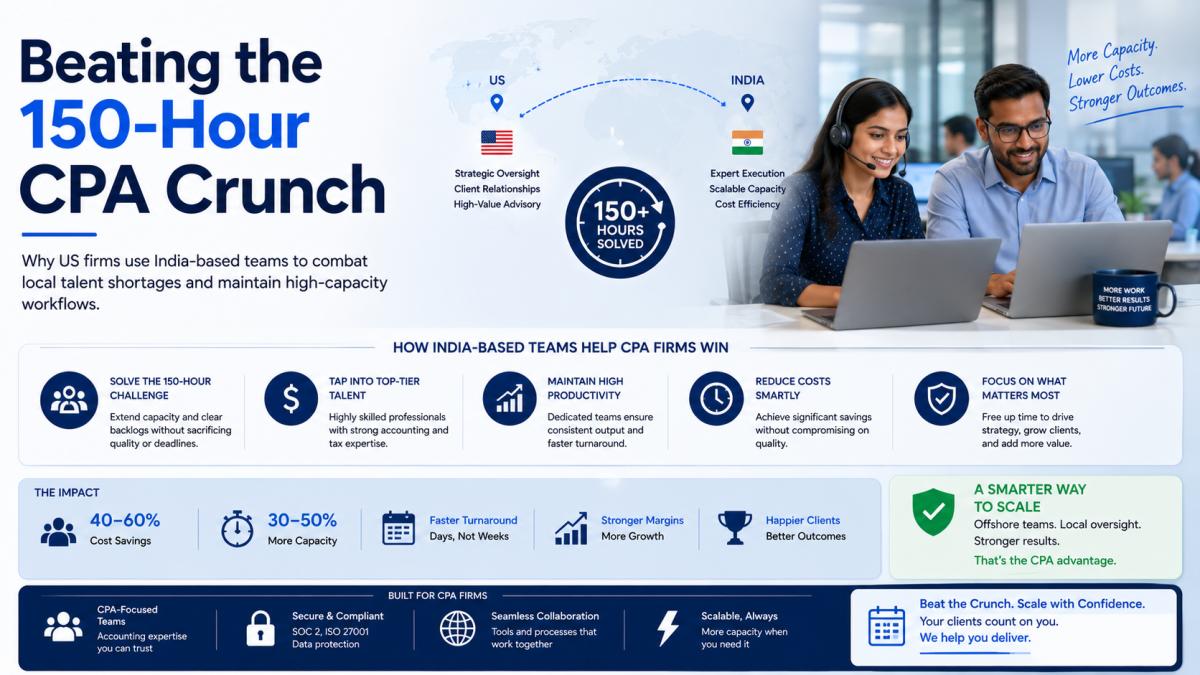
For decades, U.S. CPA candidates have had to fulfill a strict educational prerequisite before taking their state licensing exams. Namely, students needed a total of 150 semester hours of college education to sit for the CPA exam. The so-called 150-hour rule was supposed to raise the quality of accounting professionals by increasing the minimum CPA education level.
This regulatory shift created a significant barrier to entry for aspiring CPAs, generating a lower supply of accounting professionals compared to other industries. The 150-hour CPA rule, combined with the lack of CPA staffing flexibility, created a persistent CPA talent shortage at firms around the country. This shortage is a primary catalyst for U.S. firms to hire Indian accountants and build offshore accounting teams.
In this guide, we’ll discuss the impact of the 150-hour rule on the accounting profession, analyze the current state of the CPA talent shortage, and explore how CPA firms can utilize a hybrid hiring strategy to address their capacity needs without relying on local CPA candidates.
The 150-hour CPA rule’s impact on the profession
The 150-hour rule was implemented nationwide in the United States in the late 1980s and early 1990s. The rule mandated that all CPA candidates hold at least 150 credit hours of college education to be eligible to take the CPA exam.
Prior to the rule change, CPA candidates only needed 120 credit hours (a standard bachelor’s degree). The additional 30 credit hours usually took the form of a fifth year of college or an additional year of graduate studies. However, the 150-hour rule did not necessarily require CPA candidates to gain new knowledge and skills in accounting during the additional 30 credit hours.
The additional year of education created an opportunity cost for CPA candidates who would have graduated with another degree, such as finance or computer science. During the time that aspiring CPAs studied for their fifth year, students with similar qualifications could have completed their degrees and secured full-time positions in higher-paying industries.
The combination of the additional opportunity cost and the burden of tuition fees for the fifth year created an incentive for many students to pursue other degrees. Moreover, CPA candidates who continued to study accounting faced a steeper learning curve in their professional development.
The opportunity cost created by the 150-hour rule has resulted in a significant CPA talent shortage in recent years. The following factors illustrate how the 150-hour rule affects the talent pipeline for CPA firms:
| Factor | Description |
|---|---|
| Additional year of education | Extra tuition fees with no additional income from a CPA job |
| Opportunity cost compared to peers | Fewer years of work experience at the same professional level |
| Decline in CPA candidates | A general decrease in the number of CPA exam takers over time |
| Decrease in entry-level CPA hires | Fewer qualified CPA candidates willing to start at the bottom |
| Fewer senior-level CPAs | Ready to retire and reduce the number of available mentors |
| Higher cost per hire | Higher entry-level salaries and signing bonuses due to fewer candidates |
The combination of these factors creates a lower supply of accounting professionals, especially junior-level CPAs. At the same time, the demand for CPA services continues to grow, especially among small- and medium-sized CPA firms that struggle to serve all their clients adequately. These dynamics have prompted states to revisit the 150-hour rule and encouraged CPA firms to explore new ways to fill entry- and mid-level accounting positions.
States are revising the 150-hour rule
The negative impact of the 150-hour rule on the CPA talent pipeline has prompted several states to adopt new legislation that makes it easier for aspiring CPAs to enter the profession. In most cases, the new laws allow CPA candidates to complete 30 additional hours of work experience instead of the additional year of college education.
The following states have either adopted new CPA licensure requirements or are set to do so soon:
| State | Description |
|---|---|
| Ohio | Bachelor’s degree + 2 years of experience or a master’s degree + 1 year of experience |
| Virginia | Bachelor’s degree + 2 years of experience |
| North Carolina | Additional CPA pathway available from 2026 |
| New Jersey | Bachelor’s degree + 2 years of experience (effective 2026) |
| Oklahoma | Additional CPA pathway (effective November 2026) |
| Arizona & Arkansas | New CPA pathway legislation taking effect in 2026 |
While the changes should improve the long-term CPA talent pipeline, they will not address the firm’s urgent capacity needs. Most notably, CPA firms that rely on local hiring will have to wait several years before they see a noticeable increase in the number of available candidates. By contrast, firms that utilize offshore talent can address their staffing needs faster and ensure higher quality control during the hiring process.
Why the CPA talent shortage affects high-capacity CPA firms most
Every CPA firm has a basic workload capacity that it needs to fulfill regardless of the number of clients. For example, a company will always have to perform bookkeeping services for its clients in addition to higher-level advisory services. For most firms, the basic workload capacity consists of accounting services that a firm provides to all its clients, regardless of their size.
However, the CPA talent shortage makes it harder for firms to fulfill their basic capacity needs, especially for recurring tasks such as bookkeeping, reconciliation, payroll, and tax season processing. The reduced talent pool of entry-level CPAs creates a ripple effect that manifests in the following challenges:
Reduced capacity to take on new clients
Due to limited staffing resources, many CPA firms have to turn away new clients despite having the expertise to serve them.
Higher turnaround time for tax and accounting services
Firms with fewer employees have to distribute their workload among their existing staff, which increases the time it takes to deliver services.
Increased risk of senior staff burnout
Senior staff members such as partners and managers dedicate more time and effort to entry-level tasks due to the limited presence of junior workers.
Higher cost per hire
A smaller talent pool results in higher entry-level salaries and additional compensation such as signing bonuses.
Inconsistent service quality
Junior CPAs are more likely to make mistakes when under pressure, which affects the quality of services and increases the risk of errors during tax season processing.
Higher turnover rates
Chronic senior staff burnout and a lack of entry-level workers create a cycle that leads to higher turnover rates and an increased reliance on temporary staff.
Addressing the root causes of the CPA talent shortage requires both private and public initiatives. While states attempt to revise the 150-hour rule, CPA firms have to consider alternatives that provide immediate relief. One such option is to build offshore accounting teams that address the capacity needs of CPA firms while supporting local CPA hires.
Why U.S. CPA firms are building India-based accounting teams
India has one of the largest talent pools of finance and accounting professionals in the world. These professionals possess extensive experience with U.S. tax laws, accounting software, and financial reporting standards. As a result, India-based accountants can serve as valuable offshore teammates for CPA firms that need to scale their capacity.
The following benefits demonstrate why CPA firms are using offshore accounting teams to address their capacity needs:
| Benefit | Description |
|---|---|
| Access to a larger talent pool | Compared to the U.S., India has a significantly greater supply of accounting professionals |
| Faster hiring process | Experienced offshore teammates can begin working within days rather than months |
| Lower cost compared to local hires | On average, offshore employees cost 50-60% less than local hires |
| 24/7 availability due to time zones | Work completed by offshore teams is reviewed the next morning |
| Greater flexibility to scale capacity | Up and down as needed, with no long-term commitment |
| Experienced workers assist senior CPAs | Offshore teammates handle entry-level tasks so senior CPAs can focus on higher-level responsibilities |
| Reduced turnover risk | The staffing partner is responsible for finding replacements rather than the CPA firm |
Hybrid offshore/local CPA teams are particularly valuable for CPA firms that want to maximize their capacity utilization. These teams allow CPA firms to dedicate their senior and local CPAs to value-added activities while offshore teammates handle the rote and repetitive elements of accounting and tax services. As a result, offshore teams enable CPA firms to operate at maximum capacity without relying on scarce local resources.
How CPA firms are using India-based accounting teams today
A hybrid offshore/local CPA team usually consists of India-based accounting professionals who perform specific tasks within the firm’s standard operating procedures. In most cases, India-based accountants serve as an extension of the firm rather than a separate subcontractor.
Some of the common tasks performed by India-based accounting teams include the following:
| Task | Description |
|---|---|
| Bookkeeping and reconciliation | Nighttime processing with morning reviews by local CPAs |
| Tax preparation assistance | Increased support during tax season with reduced assistance afterward |
| Payroll processing | Outsourced, predictable payroll cycles without local CPA involvement |
| Financial reporting and month-end close | Supportive services so local CPAs only need to review the information |
| Accounts payable and receivable management | Management of cash flow operations to free up senior CPAs |
Using offshore accounting professionals allows CPA firms to increase their capacity utilization while continuing to serve their clients to the highest standard. Local CPAs can dedicate their time and energy to higher-level responsibilities while offshore teammates handle repetitive tasks.
Common questions about using offshore accounting professionals
Is an offshore accounting team secure?
A reputable staffing partner that serves CPA firms understands the importance of security in the financial services space. As such, offshore accounting professionals can provide the same level of security as local teammates. Security measures include standard NDAs, restricted access to sensitive information, and international security certifications.
Will the quality of work provided by an offshore team be sufficient?
India-based accounting professionals can perform the same responsibilities as their U.S.-based counterparts. Hybrid offshore/local CPA teams ensure that every aspect of client service meets the firm’s quality standards. Moreover, offshore teammates are trained to follow U.S. tax laws and regulations, as well as the specific accounting software used by the CPA firm.
Will my clients know that their services are partially delivered by an offshore team?
In most cases, clients will not be aware that any aspect of their service is delivered by an offshore team. This is especially true for white-labeled offshore accounting services. The CPA firm serves as the sole point of contact for clients and is responsible for the quality of service and client experience.
How do hybrid offshore/local CPA teams differ from simply outsourcing the entire operation?
Most CPA firms do not outsource their entire operation to one entity. Hybrid offshore/local CPA teams allow firms to maintain control of their client services by utilizing offshore teammates as an extension of the local team. As such, CPA firms can retain their decision-making authority and offer their clients the same level of service as a fully local team.
Signs that a CPA firm needs offshore staffing support
A CPA firm may benefit from considering offshore accounting professionals if the following situations occur:
| Situation | Description |
|---|---|
| Local hiring efforts have failed | Several open positions have gone unfilled for an extended period |
| Senior CPAs perform entry-level tasks | Partners and managers spend considerable time handling bookkeeping and other entry-level tasks |
| The firm has turned away new clients | The firm was unable to serve a new client due to a lack of capacity |
| Higher salaries fail to attract new candidates | Increased entry-level salaries have failed to result in new hire |
| Tax season causes staff burnout | Tax season always overwhelms the firm’s staff |
The 150-hour rule will eventually alleviate the CPA talent shortage as more students pursue accounting degrees and CPA certifications. However, this process will take several years, and the CPA firms that continue to thrive are those that do not rely on the slow-moving local hiring market. These firms utilize a hybrid staffing model that allows them to operate at maximum capacity regardless of the local CPA talent shortage.
If your CPA firm is considering offshore or hybrid offshore/local accounting teams, you can begin your journey by talking to a staffing expert. Exuberant Global can help you determine the best options for your CPA firm while supporting your local CPA staff.
You can also learn more about our outsourced accounting services or contact us directly to discuss your options.
Ready to Scale Your Business?
Connect with our experts to learn how our outsourcing solutions can drive growth.
BOOK A DISCOVERY CALL