 : +1 308-7304-232
 : +44 (744)-139-7094
 : +61 4 8080-3582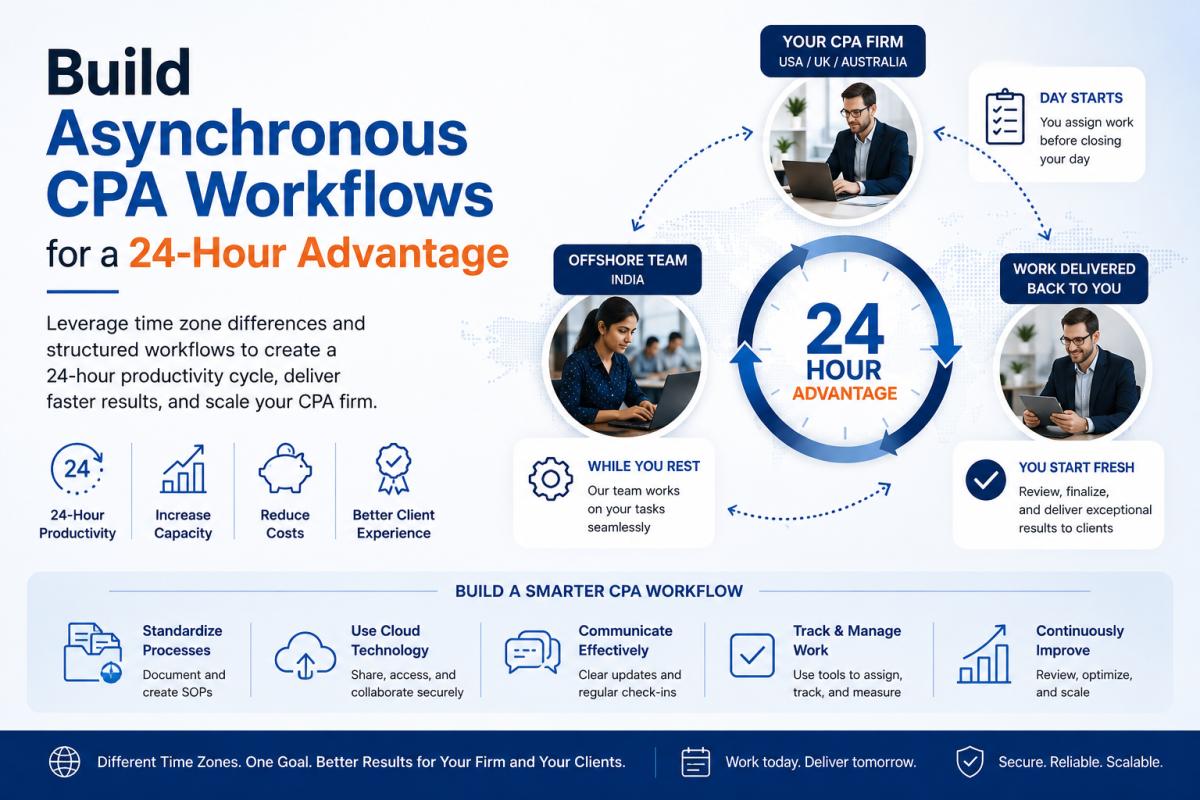
Rethinking Time Zone Differences: From Operational Friction to Competitive Fuel
Most managing partners across the US, UK, Canada, and Australia flinch when you mention time zone differences. Evaluating offshore talent in South Asia or Southeast Asia usually triggers an immediate defense mechanism: a 10-hour gap feels like a setup for stalled communication, lost days, and missed client deadlines. I get it. If you try to force a real-time, synchronous operating model onto a team spread across the globe, you will fail.
If your firm's process relies on a senior manager in London or New York jumping on Teams every time a junior staff member hits an unclassified transaction, offshore staffing is going to feel painful. But when forward-thinking CPA firms intentionally build their operating model around asynchronous workflows, that distance flips. It stops being a handicap and becomes an incredible productivity multiplier.
Asynchronous work is straightforward: team members complete tasks independently without waiting around for real-time answers. That simple structural shift turns your firm into a continuous 24-hour service engine. While your local team sleeps, an offshore crew is clearing reconciliations, building tax workpapers, running payroll, and drafting monthly financial packs. By 8:00 AM, yesterday's queued work is sitting right there—completed, reviewed, and ready for client delivery.
Key Performance Indicator: CPA firms running structured asynchronous handoffs cut tax preparation cycles by up to 60% while completely wiping out peak-season overtime for domestic senior managers by shifting raw processing off-hours.
The Anatomy of a 24-Hour Accounting Production Loop
Let's look at how this actually plays out on the ground. The goal here isn't fancy jargon—it's maximizing output while your local office is closed so your expensive domestic talent can focus on advisory work, client relationships, and review, rather than manual data entry.
Here is what a clean operational loop looks like between a US East Coast practice and an offshore team operating in India (IST, UTC+5:30):
- 5:00 PM EST (2:30 AM IST): The onshore team wraps up the workday. Before logging off, managers update project boards, attach client files, and record quick 60-second Loom videos highlighting specific edge cases or client quirks for each queued file.
- 8:30 PM EST (6:00 AM IST): The offshore team logs in. They open the task manager, review assigned workpapers, watch the screen recordings, and start working through files without needing real-time hand-holding.
- 4:30 AM EST (2:00 PM IST): Primary file processing finishes. The offshore team logs any outstanding questions onto a query sheet and posts shift summaries directly to the workflow dashboard.
- 8:00 AM EST (5:30 PM IST): Onshore accountants come online. Instead of starting from scratch with raw data entry, their morning begins by reviewing finished tax returns, resolving minor flags, and delivering reports to clients.
| Operational Factor | Traditional Synchronous Model | Asynchronous 24-Hour Model |
|---|---|---|
| Task Delivery Speed | Linear (limited to an 8-hour day) | Exponential (running on a 24-hour loop) |
| Communication Channel | Ad-hoc calls and endless Slack pings | Structured tickets, Loom videos, daily logs |
| Manager Workday | Constant interruptions with routine questions | Deep focus on review, advisory, and clients |
| Turnaround Time | 5–7 business days per client file | 24–48 hours from intake to final review |
The Essential Technology Stack for Asynchronous Accounting Operations
You can't run an async firm on messy email chains or by expecting offshore staff to sit on instant messaging late into the night. That leads straight to dropped balls and burnt-out staff. High-performing practices invest in a centralized stack built specifically for clarity and context.
1. Practice Management and Task Routing
Tools like Karbon, ClickUp, or Asana serve as your single source of truth. Engagements should never exist as generic tickets like "Work on Smith LLC Tax Return." Every job needs a broken-down checklist with standard operating procedures (SOPs) linked right inside the task, assigned roles, and clear handoff rules. When a status moves to "Ready for Offshore Review," everyone knows what happens next.
2. Contextual Screen Recording and Async Messaging
Written notes often fail to explain subtle ledger quirks. Requiring team leads to record a quick screen share via Loom or Vidyard eliminates back-and-forth messaging instantly. A manager can talk through a complex chart of accounts or explain a weird client transaction in under two minutes. The offshore accountant can pause, rewatch, and follow along while working overnight.
3. Centralized Knowledge Repositories
SOPs can't be static PDFs buried in a shared folder. Modern firms use platforms like Notion, Trainual, or internal wikis to host living instructions for software setups, indexing protocols, and client-specific rules. When an offshore accountant hits an unusual scenario, they search the knowledge base and find the answer immediately instead of waiting for morning.
4. Secure Cloud Ecosystems
Cloud-native tools like QuickBooks Online, Xero, Drake Hosted, and UltraTax CS give teams secure access anywhere in the world. MFA, password managers, and locked-down cloud desktop environments ensure complete alignment with AICPA professional standards around data confidentiality and remote system access.
Establishing Bulletproof Handoff Protocols and SOPs
Handoffs make or break async firms. If a file leaves a domestic desk with missing client documents or vague instructions, the offshore team hits a wall six hours later. With no onshore staff awake to clarify, that client file sits untouched until morning—killing your 24-hour speed advantage.
To fix this bottleneck, smart practices enforce strict "Definition of Ready" (DoR) and "Definition of Done" (DoD) standards for every engagement.
The Definition of Ready (DoR)
Before a file drops into the offshore queue, the onshore manager confirms that:
- All bank statements, 1099s, W-2s, and organizers are uploaded to the portal.
- Prior-year workpapers and trial balances are indexed using standard firm naming rules.
- Client-specific parameters (e.g., "Expensing equipment purchases under $2,500") are clearly noted on the ticket.
- Target deadlines and hour budgets are set up front.
The Definition of Done (DoD)
When the offshore team wraps up their shift, the work package must hit these exact standards before returning to the domestic queue:
- All bank, credit card, and ledger accounts are reconciled to a zero-variance balance.
- Unresolved questions are logged on a standardized query sheet with recommended accounting treatments attached for manager approval.
- Workpapers are linked and saved in the correct cloud directory structure.
- A daily shift summary is logged in practice management detailing completed work, time spent, and next steps.
Applying Asynchronous Workflows Across Core Practice Areas
Async workflows aren't just for routine transaction tagging. When implemented systematically, async protocols accelerate output across every vertical in a modern public accounting practice.
1. Daily Bookkeeping and Bank Reconciliations
Bookkeeping tasks are tailor-made for off-hours execution. When you hire a dedicated offshore bookkeeper, bank feeds get cleared, updates get posted, and general ledgers get reconciled while your physical office is closed. Clients wake up to updated financial dashboards every morning, allowing your managers to focus on advisory discussions instead of chasing uncleared checks.
2. Tax Preparation and Workpaper Assembly
Tax season regularly pushes local teams to the brink with massive overtime and review bottlenecks. Plugging specialized outsourced tax preparation into an async workflow fixes that pressure. Onshore staff handle intake and client meetings during the day. At 5:00 PM, files shift to offshore tax accountants who enter source docs, calculate initial depreciation schedules, and double-check deductions against current IRS tax filing guidelines. Onshore tax managers step in the next morning to review finished draft returns rather than starting calculations from scratch.
3. Month-End and Year-End Closing Services
Closes drag on for weeks when domestic staff get bogged down with routine trial balance reconciliations while managing daily client demands. Leaning on an offshore team that specializes in year-end accounting and closing services compresses 15-day closes down to 3 days. Adjusting journal entries, asset schedules, and deferrals happens overnight, getting clean financials into clients hands fast.
Navigating Query Resolution and Data Security Compliance
The single biggest fear partners voice about offshore work is handling questions. What happens when an offshore accountant hits an unfamiliar transaction? Does the entire job stall for 24 hours while waiting for clarification?
Leading practices use two simple strategies to keep work moving:
The 80/20 Completion Rule
Offshore accountants should never stop work completely because of isolated questions. If an accountant encounters five mystery transactions in a 500-item ledger, they finish the 495 clear items, park the five ambiguous items in a temporary clearing account, document the queries, and submit the file at 80%+ completion. The onshore manager resolves the small query batch in minutes the next morning.
Strategic Shift Overlaps
Pure async hours drive raw production, but maintaining a 90-to-120-minute daily shift overlap keeps teams aligned. Aligning early morning US/UK hours with late afternoon offshore hours allows managers to run brief standups, clear outstanding questions live, and give technical guidance without pulling anyone away from their deep-focus time.
Data security must also remain central to your operational setup. Offshore infrastructure needs SOC 2 compliant server setups, single sign-on, strict DLP settings that block local file downloads, and secure remote desktop environments. Following international privacy regulations keeps client data safe while enabling seamless global delivery.
Building Your Firm’s Asynchronous Offshore Advantage
Shifting an accounting firm from reactive, real-time habits to a structured global model takes deliberate effort. You have to drop informal communication habits, document core processes, and give your team modern tools. But the payoff is massive.
By building a dedicated offshore team integrated directly into your cloud tech stack, you effectively double your capacity without expanding your local office footprint or burning out your team. Time zones stop being an obstacle—they become your greatest strategic asset, driving faster turnarounds, healthier margins, and better client service.
If you're ready to modernize how your practice operates and scale your delivery team, contact Exuberant Global today to schedule a strategic consultation and build a custom offshore staffing strategy for your firm.
Ready to Scale Your Business?
Connect with our experts to learn how our outsourcing solutions can drive growth.
BOOK A DISCOVERY CALL