 : +1 308-7304-232
 : +44 (744)-139-7094
 : +61 4 8080-3582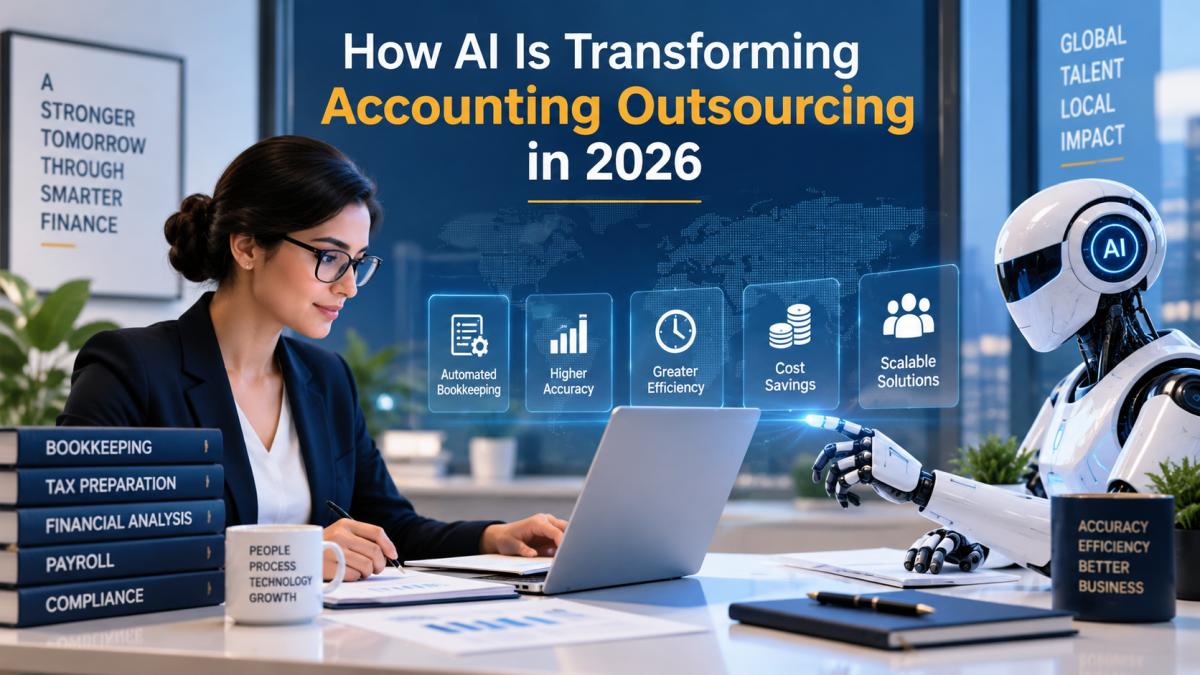
How AI Is Transforming Accounting Outsourcing in 2026
AI stopped being a pilot project in accounting outsourcing somewhere around 2025. Here's what's actually changed, what the data says, and what to check before you trust a provider's "AI-powered" pitch.
Every outsourcing provider now claims to be "AI-powered." Most of that is marketing. But underneath the noise, something real has shifted in how finance and accounting work actually gets done — and it's changing what firms should expect from an outsourcing partner in 2026, not just how much they should expect to pay.
This isn't a hype piece. It's a breakdown of where AI adoption in accounting genuinely stands right now, what "AI agents" mean in practice versus in a sales deck, and how to tell a provider using AI well from one just using the word.
The State of AI Adoption in Accounting Right Now
The numbers moved faster than most firms expected. Gartner has tracked CFO adoption of AI climbing from roughly 10% in 2019 toward an expected 50% by 2025 — a fivefold jump in under six years. Deloitte's CFO Signals survey now puts the share of CFOs who consider AI "extremely important" to their operations at 87%.
On the practitioner side, Zeni's 2026 Accountant AI Survey found that 54% of accounting professionals now use AI daily, and a third of respondents named AI tools their single biggest investment priority for the year ahead — ahead of hiring and advisory services.
Sources: Gartner CFO Priorities research, Deloitte CFO Signals survey, Zeni 2026 Accountant AI Survey, Auxis 2026 Finance & Accounting Outsourcing Trends report — verify current figures against the original reports before citing them as your own data.
But adoption isn't the same as confidence. Gartner's CFO research also shows that even as AI adoption in finance has nearly doubled in two years, roughly 65% of CFOs still don't feel confident they're getting meaningful value out of it. That gap — high adoption, low confidence — is exactly where outsourcing is stepping in.
From "Tools" to "Teammates": What AI Agents Actually Do
A few years ago, "AI in accounting" mostly meant Robotic Process Automation (RPA) — rule-based scripts that copied data from one system to another. What's changed in 2026 is the shift toward AI agents: systems that don't just execute a fixed rule, but reason through a workflow and flag what needs a human.
| Function | What AI Now Handles | Where a Human Still Steps In |
|---|---|---|
| Accounts Payable / Receivable | Matching invoices, chasing routine approvals, predicting late payments | Exceptions, disputes, vendor negotiation |
| Reconciliation | Matching transactions in real time as they post, not at month-end | Investigating true mismatches and unusual entries |
| Compliance checks | Scanning every ledger entry against current tax rules and standards | Reviewing flagged anomalies, filing judgment calls |
| Cash flow forecasting | Pattern-based prediction from historical and live transaction data | Strategic decisions built on the forecast |
This is why real-time reconciliation matters more than it sounds. Instead of finding a discrepancy three weeks after month-end close, a firm using AI-assisted reconciliation sees it the day it happens — audit-ready books every day of the year, not just at close.
Why This Matters More for Outsourcing Than for In-House Teams
Building proprietary AI tooling in-house is expensive — the model licensing, the integration work, the ongoing tuning. Most small and mid-sized firms will never justify that R&D spend on their own. Outsourcing changes the math: a provider that has already built AI-assisted workflows spreads that cost across every client it serves, effectively letting firms buy "AI-as-a-service" instead of building it.
That's part of why the finance and accounting outsourcing (FAO) market itself is growing so fast. Industry sizing from Startus Insights puts the global FAO market at roughly $54.79 billion in 2025, on track to reach $81.25 billion by 2030 — and the US offshore accounting segment specifically is projected to exceed $130 billion by 2028, growing at around 15% a year. AI isn't the only driver of that growth, but it's accelerating it.
Five Ways AI Is Changing What Outsourcing Providers Deliver
1. Hybrid nearshore-offshore delivery models
Providers increasingly blend nearshore teams for advisory-heavy work that benefits from real-time collaboration with offshore teams for high-volume processing — rather than picking one location for everything.
2. End-to-end providers over point solutions
CFOs are consolidating toward fewer, broader relationships. Auxis reports that 96% of CFOs now rely on at least one third-party finance and accounting provider, up from 79% the year before — and they're increasingly looking for partners who combine advisory, digital enablement, and execution rather than just extra headcount.
3. ESG and regulatory data as a standard deliverable
Environmental, social, and governance (ESG) reporting has moved from optional to expected in many jurisdictions. Outsourcing partners are increasingly asked to track and structure ESG data with the same rigor as a P&L, not treat it as a side request.
4. AI-assisted compliance built into daily workflow
Rather than catching errors during a periodic review, AI-assisted compliance checks now flag anomalies — a duplicate payment, a misapplied depreciation schedule — as entries are made, routing them to a human before they reach a final report.
5. A widening talent gap that outsourcing is built to absorb
Startus Insights projects that roughly 75% of currently practicing CPAs will retire within the next 15 years. Zeni's 2026 survey found 60% of accounting professionals — and 80% of public accountants specifically — already struggle to hire qualified staff. Offshore and AI-supported delivery models exist largely because that gap isn't closing on its own.
Want an outsourcing partner that uses AI as a tool, not a buzzword?
Talk to Exuberant Global about a dedicated accounting team built around your software, with human review on everything that reaches your clients.
Book a Free ConsultationThe Adoption-to-Confidence Gap, Visualized
The single most important chart in this space isn't adoption — it's the gap between adoption and confidence. Here's what that gap looks like across the finance function.
The last figure is the inverse of Gartner's reported 65% of CFOs lacking confidence in realizing meaningful AI value — the gap this section is built around.
Where Firms Get This Wrong
Treating "AI-powered" as a feature instead of a process
A provider bolting an AI chatbot onto an unchanged workflow isn't the same as one that has redesigned reconciliation, AP, and compliance review around AI-assisted checks. Ask what specifically changed in their process, not just what software they use.
Assuming AI adoption equals AI value
Remember the confidence gap: adoption has nearly doubled, but most CFOs still aren't confident they're getting real value from it. The same applies to outsourcing providers — adoption of a tool tells you little about whether it's actually improving accuracy or turnaround for your account specifically.
Removing the human review layer too soon
Every credible use case above — AP, reconciliation, compliance, forecasting — still routes exceptions to a person. A provider claiming "fully automated, no review needed" is a red flag, not a selling point.
What to Ask Before Choosing an AI-Enabled Outsourcing Partner
- ✔ Ask exactly which workflows are AI-assisted versus fully manual, step by step
- ✔ Ask how many review layers sit between an AI-flagged item and your final report
- ✔ Ask what happens when the AI gets something wrong — who catches it, and how fast
- ✔ Ask whether their AI tools are proprietary or licensed, and how client data is handled inside them
- ✔ Ask for a specific, measurable example of what AI has improved for an existing client — turnaround time, error rate, or close speed
Frequently Asked Questions
Is AI actually replacing outsourced accountants?
No — in every credible use case, AI handles high-volume, pattern-based work and routes exceptions and judgment calls to a human. It's changing what accountants spend their time on, not eliminating the role.
What's the difference between RPA and AI agents in accounting?
RPA follows fixed, rule-based scripts to move data between systems. AI agents can reason through a workflow, adapt to variations, and flag anomalies a rule-based script would miss.
Does using an AI-enabled outsourcing provider cost more?
Not necessarily. Because the provider spreads its AI tooling costs across many clients, firms typically get the benefit — faster turnaround, fewer errors — without bearing the R&D cost of building it themselves.
Is it safe to let AI handle compliance checks on client data?
AI-assisted compliance checks are generally used to flag anomalies for human review, not to make final compliance decisions unsupervised. Ask any provider exactly where the human sign-off happens in that process.
How can a small firm evaluate an outsourcing provider's AI claims?
Ask for a specific measurable outcome from an existing client — reduced turnaround time, fewer reconciliation errors, faster close — rather than accepting general claims about "AI-powered" delivery.
Ready to Scale Your Business?
Connect with our experts to learn how our outsourcing solutions can drive growth.
BOOK A DISCOVERY CALL