 : +1 308-7304-232
 : +44 (744)-139-7094
 : +61 4 8080-3582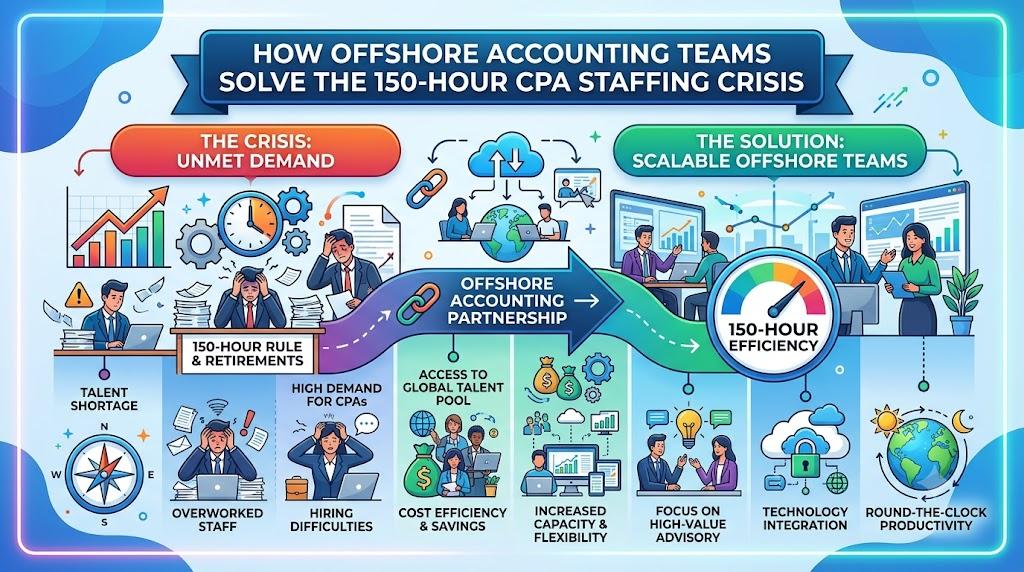
Ask a CPA firm partner what's actually broken about hiring right now, and the 150-hour rule usually comes up within the first minute. It's not that the rule is complicated — it's that it quietly reshaped who even considers becoming a CPA in the first place, and the accounting profession is still paying for that decision two decades later. This piece goes deeper than the usual "there's a shortage" framing. It looks at the actual mechanics of why the 150-hour CPA staffing crisis hits firms the way it does and walks through exactly how offshore accounting teams solve it — and just as importantly, where they don't.
The Numbers Behind the Crisis
It helps to see the actual scale of what firms are up against, rather than treating "shortage" as an abstract word. The number of candidates sitting for the CPA exam each year has been declining for over a decade, even as demand for accounting services has grown. At the same time, a large share of the profession's most experienced partners and managers are aging into retirement on a completely separate timeline. Layer state-by-state licensure reform on top of that—some states have already adopted alternative pathways, others won't finish rolling theirs out until later in 2026—and you get a pipeline problem that's shrinking on one end and only slowly refilling on the other.
| Pressure Point | What It Means for Firms |
|---|---|
| Declining CPA exam candidates | Fewer new hires available for staff and associate-level roles every year |
| Senior partner retirements | Fewer mentors and reviewers available just as workload increases |
| Uneven state licensure reform | Multi-state firms face inconsistent rules and timelines through 2026 and beyond |
| Rising cost per local hire | Firms bidding against each other for the same shrinking candidate pool |
The 150-Hour Rule Didn't Just Reduce Supply — It Reshaped Who Applies
Most explanations of the 150-hour CPA rule stop at the surface: candidates need 150 college credit hours instead of the standard 120 to sit for the CPA exam, which means an extra year of school most students didn't need for any other business degree. That's true, but it undersells what actually happened. A finance or business-analytics degree gets a graduate into a well-paying job a full year earlier, with no extra tuition. Accounting, under this rule, quietly became the more expensive, slower path into a comparable career. Talented students didn't stop being capable of the work — they just stopped choosing it, which is a very different, harder problem to fix than a simple headcount shortfall.
The Nuance Most Coverage Misses: This Is a Hollowed-Out Middle, Not Just Fewer New Hires
The CPA staffing crisis isn't evenly distributed across experience levels, and that's the part that makes it so disruptive for firms trying to plan around it. Entry-level hiring has thinned out because fewer students finish the pipeline. At the same time, a large cohort of senior partners and managers is retiring out of the profession on a completely separate timeline, unrelated to the 150-hour rule itself. What's left is a shrinking middle tier — the three-to-eight-year staff who would normally be stepping up to fill the gap left by retiring seniors, except there simply aren't enough of them coming through. Firms aren't just short-staffed; they're short-staffed at exactly the experience level needed to keep the next generation of the firm running.
State Reform Is Real, But It's Creating a Patchwork Problem of Its Own
Most states have introduced or passed legislation offering an alternative path to CPA licensure — typically a standard bachelor's degree plus two years of supervised experience instead of the extra 30 credit hours. That's a genuine, meaningful fix for the long-term pipeline. But it's rolling out unevenly: some states adopted it years ago, others are implementing it through 2026, and a few haven't finalized their position at all. For firms operating across state lines, this creates a second-order problem layered on top of the original one—keeping track of which state's licensure rules apply to which staff member and how long it'll actually take before any of this shows up as more hireable candidates in your specific market. Reform helps the profession in five to ten years. It does nothing for the return you need prepared next April.
Why the Usual Fixes Don't Actually Solve This
Firms have tried the obvious plays, and it's worth being honest about why they fall short:
- Raising salaries doesn't create more CPAs—it ; it just bids up the same fixed, shrinking pool, which mostly benefits candidates who were already going to enter the field anyway
- Recruiting more aggressively only redistributes existing talent between firms; it doesn't grow the overall supply
- Leaning harder on automation helps with data entry and reconciliation, but the judgment-heavy review work still needs a trained person, and there still aren't enough of those
- Bringing back retirees part-time is a real stopgap, but it's not a scalable, repeatable staffing strategy for a growing firm
None of these actually address the root problem: there simply aren't enough qualified people entering the local pipeline, at any price, on any timeline that matches a firm's actual staffing needs.
How Offshore Accounting Teams Actually Solve This
This is where offshore accounting staffing does something the fixes above can't: it sidesteps the constrained pipeline entirely instead of trying to compete harder for the same shrinking pool of US-licensed CPAs.
It separates "CPA-licensed work" from "CPA-adjacent work."
Here's the nuance that matters most: the vast majority of a CPA firm's day-to-day workload — bookkeeping, reconciliations, tax return preparation, payroll processing, financial statement drafting — doesn't legally require a US CPA license to perform. It requires a trained accounting professional, with a licensed CPA reviewing and signing off at the end. Offshore accounting teams, often staffed by India's Chartered Accountants and commerce graduates trained specifically in US GAAP and tax law, can absorb nearly all of that volume, leaving your actual licensed CPAs to spend their scarce hours on the judgment calls and sign-offs that legally require them.
It restores the missing middle tier, functionally if not literally
Remember the hollowed-out middle from earlier? An offshore team doesn't replace a three-to-eight-year US CPA — but it can absorb the volume that tier used to handle, which frees your remaining mid-level and senior staff to actually do mid-level and senior work instead of being buried in the entry-level tasks nobody was hired to do.
It replaces a multi-month hiring cycle with a multi-day one
Recruiting a qualified local CPA candidate right now can take months, if a suitable candidate is even available in your market at all. A trained offshore accounting professional can typically be onboarded and contributing within one to two weeks. For a firm trying to staff up ahead of tax season, that difference alone often determines whether the season is survivable.
It changes the cost equation completely
Offshore accounting staffing typically costs 50–65% less than the fully loaded cost of an equivalent local hire once you factor in the rising salaries that come from a shrinking local talent pool. That's not just a cost saving — it's a way of removing your firm from the local bidding war for the same scarce candidates every other firm in your market is also chasing.
Before CPA review & sign-off Thin mid-level staff Overloaded with entry-level volume After CPA review & sign-off Mid-level staff, freed up The offshore team absorbs entry-level volume →
What Offshore Teams Can't Fix — and Why That's Fine
It's worth being direct about the limits here, because overselling this creates exactly the kind of disappointment that makes firms sour on the model. Offshore accounting professionals cannot sign attest work, cannot represent themselves as US-licensed CPAs, and cannot replace the actual judgment and legal accountability a licensed CPA carries. Nothing about offshore staffing changes who's allowed to sign a return or an audit opinion. What it changes is how much of the work leading up to that sign-off has to be done by someone holding that scarce license in the first place — which, given how constrained that license has become, is exactly where the leverage is.
A Realistic Before-and-After
Picture a five-partner firm with 20 local staff heading into tax season understaffed by two open staff accountant roles that have been posted for four months with no qualified applicants. Before building an offshore team, the partners themselves are pulled into reviewing basic reconciliations and chasing missing client documents — work that's beneath their license but has nowhere else to go. Deadlines slip. A few clients start asking why turnaround has gotten slower than last year.
After building a small offshore team — say, two bookkeepers and a tax preparation specialist — that same firm's partners go back to spending their hours on review, client calls, and the advisory conversations that actually justify their rate. The offshore team handles the reconciliations and first-draft returns overnight, so by the time local staff log in each morning, there's reviewable work waiting rather than a blank slate. The two open local roles stop being an emergency because the volume they were meant to cover is already being handled elsewhere.
How This Actually Gets Built in Practice
| Task | Who Handles It |
|---|---|
| Bookkeeping, reconciliations, data entry | Offshore team |
| First-draft tax return preparation | Offshore team |
| Payroll processing, AP/AR management | Offshore team |
| Review, client advisory, judgment calls | Local CPA |
| Final sign-off, attest to work | Local CPA (required by law) |
Common Mistakes Firms Make Trying to Solve This
- Waiting until a role has been open for months before considering offshore staffing, instead of building it into the hiring plan proactively
- Treating the offshore team as a side experiment rather than integrating them into real client workflows from day one, which delays any real capacity benefit
- Scaling too fast, too early — adding several offshore roles before the first hire is fully integrated, which leads to underutilized capacity rather than a smooth ramp-up
- Choosing a provider on price alone without checking certifications, quality control process, or staff retention rates, which often costs more in rework than it saves upfront
- Not clearly defining which tasks stay with local CPAs, which creates confusion about review responsibility rather than a clean division of labor
Getting Started Without Overcomplicating It
Firms that get the most value out of this tend to start small and specific rather than trying to solve every staffing gap at once. Pick the single most painful bottleneck — usually bookkeeping backlog or tax season overflow — and build one or two offshore roles around exactly that. Get those roles fully folded into real client work before adding more. This mirrors how the model is meant to work: filling in underneath the license, not replacing the judgment on top of it.
How Exuberant Global Fits Into This Specific Problem
This is exactly the gap we built Exuberant Global to close. We work with 200+ CPA and accounting firms across the US, UK, Australia, and Ireland, providing trained offshore accountants, bookkeepers, and tax preparers who absorb the volume work sitting on top of your firm's scarce CPA capacity—not replacing your licensed staff, but giving them room to actually do licensed-level work instead of drowning in the tasks underneath it. Every engagement is white-labeled and NDA-protected, and our team operates under ISO 9001, ISO 10002, and ISO 27001 certification with GDPR compliance, so the data security question that comes with any staffing decision is answered with documentation, not a verbal promise. With a 98.9% client retention rate across 12 years in this space, we've built our process specifically around the reality that the 150-hour rule created—a shortage that isn't going away on a timeline any single firm controls, but one that a well-structured offshore team can solve on your timeline instead.
Frequently Asked Questions
Can offshore staff actually replace a licensed CPA?
No, and that's not the goal. Offshore accounting professionals handle the volume work beneath the license—bookkeeping, tax prep, and payroll—while your local, licensed CPA retains review and sign-off authority on anything legally requiring that license.
Does this only help firms that are already struggling to hire?
It helps most firms feeling any pressure from the 150-hour pipeline shortage, not just firms with open, unfilled roles. Many firms use offshore staffing proactively to free up existing CPA capacity for higher-value advisory work, rather than waiting until they're understaffed to act.
How fast can this actually be stood up?
Most firms can onboard a trained offshore professional within one to two weeks, compared to a multi-month local hiring cycle for an increasingly scarce candidate pool.
Will state-level 150-hour reform eventually fix this on its own?
It should help over time, but the reforms are rolling out unevenly across states and will take years to translate into a meaningfully larger licensed pipeline. Firms need a solution that works on this season's timeline, not a ten-year policy horizon.
Do offshore staff need to be CPAs themselves?
No. Most offshore accounting professionals working with US firms are trained accountants, bookkeepers, or Chartered Accountants specializing in US GAAP and tax preparation — not US-licensed CPAs, since the work they handle doesn't legally require that license. Final review and sign-off stays with your local licensed staff.
What's the biggest risk in getting this wrong?
The most common failure mode is treating offshore staff as a bolt-on rather than a real part of the workflow. Firms that clearly define what moves offshore, integrate the team into existing software and processes, and keep local review firmly in place tend to avoid the quality and communication issues that give this model a bad reputation in the few cases where it goes poorly.
Final Thoughts
The 150-hour CPA staffing crisis isn't a problem you out-recruit or out-spend your way through — the pool everyone's competing for is fixed, at least for the next several years. Offshore accounting teams work because they don't compete for that pool at all. They handle the volume work sitting underneath the license, so the CPAs you already have can spend their scarce hours doing the work only they're legally allowed to do.
If your firm is feeling this squeeze, see how Build Your Team works with Exuberant Global, or get in touch to talk through what this could look like for your specific staffing gaps.
Ready to Scale Your Business?
Connect with our experts to learn how our outsourcing solutions can drive growth.
BOOK A DISCOVERY CALL