 : +1 308-7304-232
 : +44 (744)-139-7094
 : +61 4 8080-3582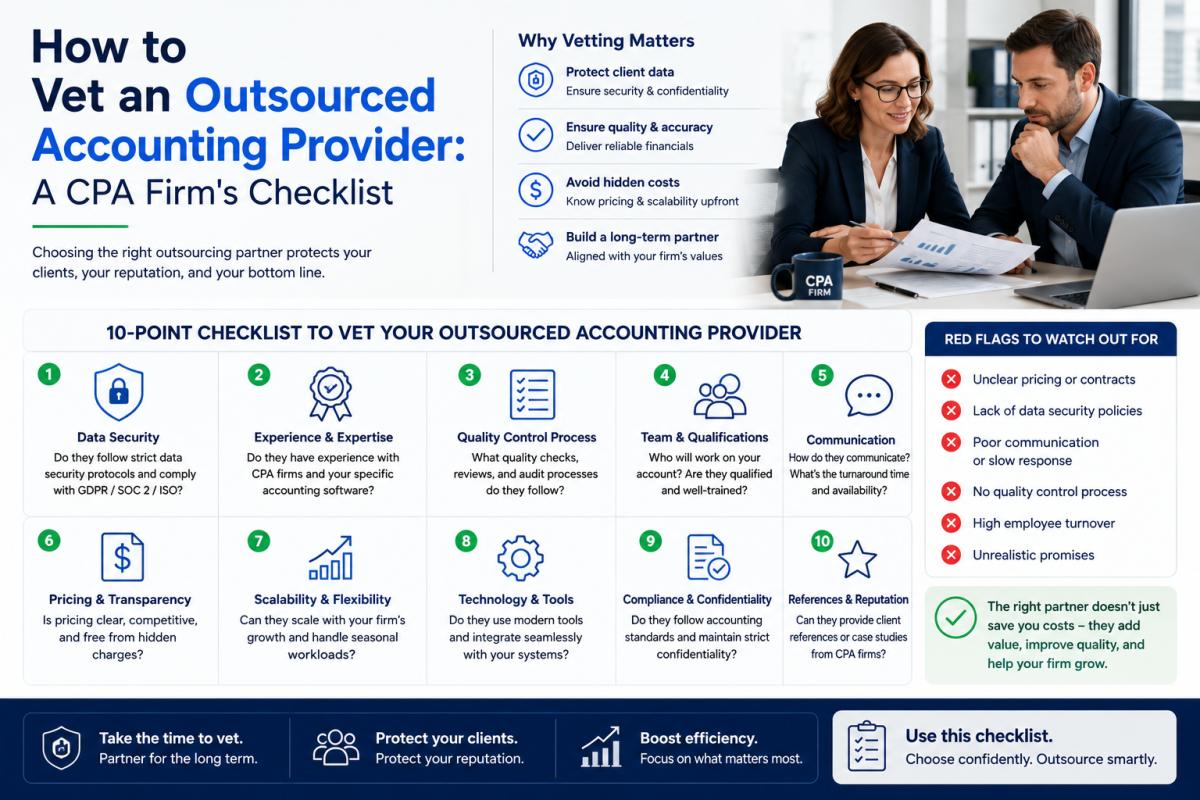
Is Outsourced Accounting Safe for Small Businesses?
If you've never outsourced anything financial before, the hesitation makes sense. You're being asked to hand your bank details, tax records, and sometimes your customers' payment information to a team you've never met in person, possibly working from a different country and time zone. That's not a small ask — and the discomfort around it is a reasonable, healthy instinct, not something to just push past because a sales page told you not to worry.
The honest answer is: yes, outsourced accounting can be very safe for small businesses — genuinely, verifiably safe, not just "probably fine." But "outsourced accounting" isn't one uniform thing, and safety depends almost entirely on which provider you choose and how seriously they treat security, not on outsourcing as a general concept. This guide walks through exactly what determines that safety, what questions actually matter, and how to tell a provider that takes security seriously from one that just says the right words.
Why This Question Deserves a Careful Answer, Not a Quick Reassurance
A lot of content on this topic is written by outsourcing providers themselves, which means it tends to rush past the legitimate concerns to get to the sales pitch. That's not helpful if you're an actual business owner trying to make a real decision about who touches your financial data. So let's slow down and actually address the concern on its own terms before getting to the reassurance.
The concern, stated plainly, is this: financial data is uniquely sensitive. A breach doesn't just cost money — it can damage customer trust, trigger regulatory scrutiny, and in the worst cases, expose your customers' personal information alongside your own. Taking this concern seriously, rather than dismissing it, is actually the first step toward evaluating outsourcing safely.
The Real Risk Isn't Geography
A lot of small business owners assume the risk is primarily about where the work happens — offshore versus domestic, one country versus another. In practice, the research and real-world incident data point somewhere else entirely: outsourcing risk is about control and oversight, not location. A well-run offshore team with strong governance, documented controls, and consistent security practices can be considerably safer than a domestic provider with sloppy internal practices and no formal security program at all.
This might feel counterintuitive at first, but think about it from a different angle: a data breach caused by an employee — anywhere in the world — downloading a client file to a personal, unencrypted laptop is a risk regardless of which country that employee is in. The location isn't what causes the breach. The absence of a policy preventing that behavior is what causes the breach. So the real question isn't "where are they," it's "how do they actually handle data day to day, and can they prove it."
What Actually Makes a Provider Safe
Here's what genuinely matters, explained in plain terms rather than technical jargon:
- Independent security certifications. SOC 2 Type II and ISO 27001 aren't just badges providers put on their website for show — they mean an outside, independent auditor has verified the provider's security practices are real, tested, and consistently followed over time, not just written down in a policy document nobody actually follows.
- Encryption, everywhere, without exception. Your data should be encrypted both while it's sitting in storage and while it's actively moving between systems — during upload, during processing, during any transfer. If a provider can't clearly and specifically explain how this works, that's a meaningful gap in their security posture.
- Multi-factor authentication and role-based access control. Not everyone at the provider's company should be able to see everything about your business. Access should be limited specifically to the people actually working on your account, with additional authentication steps beyond just a password.
- No local downloads or loose file handling. A significant share of real-world data breaches don't come from sophisticated hackers at all — they come from something as mundane as an employee downloading a file to a personal laptop that later gets lost, stolen, or compromised. Ask specifically how a provider prevents this kind of casual, informal data handling.
- A signed NDA and clear data handling agreement before anything is shared. This should be a standard part of onboarding, not something you have to specifically request or negotiate for.
- A documented incident response plan. Even the most secure providers can face an attempted breach at some point. What matters is whether they have a tested, specific plan for detecting, containing, and communicating about an incident quickly — not whether they claim breaches are impossible.
Small Business Concerns vs. What Actually Determines the Outcome
What Small Business Owners Get Wrong in Both Directions
Some business owners assume outsourcing is automatically riskier than keeping everything in-house, purely because it feels less familiar. Others swing too far the other way and assume any provider with a professional-looking website must be safe, without actually verifying anything. Both instincts skip the actual work of due diligence, which isn't complicated — it just requires asking direct questions and expecting direct, documented answers rather than reassurance.
It's also worth noting that in-house accounting isn't automatically safer by default. A lot of small businesses handle sensitive financial data with no formal security policy at all — passwords shared over text messages, spreadsheets emailed back and forth without encryption, no access controls on who can see payroll information. A well-vetted outsourced provider with real certifications and documented practices can easily be safer than an informal in-house setup that's never been evaluated from a security standpoint.
Questions to Ask Before You Commit
Before handing anything over, ask the provider directly and expect specific, confident answers: Do you hold a current SOC 2 Type II report, and can I actually review it? How exactly is my data encrypted, both while stored and while in transit? Who specifically will have access to my financial information, and how is that access limited? Have you had any security incidents in the past two years, and if so, how were they identified and handled? What happens to my data if I ever end the engagement?
A provider that's genuinely safe will answer these questions clearly, specifically, and without hesitation — they'll have already anticipated the question because they get asked it regularly by careful business owners. A provider that gets defensive, vague, or tries to redirect the conversation back to pricing and convenience is telling you something important, even if they don't say it directly.
What a Safe Onboarding Process Actually Looks Like
Beyond the certifications and policies, pay attention to how the provider actually handles your first data handoff. A safety-conscious provider will set up role-based access before requesting any sensitive information, require multi-factor authentication on any shared systems, and walk you through exactly how your data will flow through their systems. If a provider asks you to simply email spreadsheets or share login credentials over chat without any of this structure, that's a meaningful signal about how they'll handle your data going forward — the first interaction is often a preview of the ongoing relationship.
The Bottom Line
Outsourced accounting isn't inherently risky, and it isn't inherently safe either — it's exactly as safe as the specific provider you choose, and no safer than the verification work you actually do before signing. Treat the decision the way you'd treat hiring an employee who's about to see your entire financial picture: verify their credentials directly, ask pointed questions about security practices, and don't sign anything until you've gotten specific, documented answers rather than general reassurance. Done properly, this due diligence takes a few hours — a small investment of time relative to the sensitivity of what you're protecting.
Want to see exactly how a provider handles data security before committing? Exuberant Global is happy to walk through our security practices and controls directly — get in touch at exuberantglobal.com.
Ready to Scale Your Business?
Connect with our experts to learn how our outsourcing solutions can drive growth.
BOOK A DISCOVERY CALL