 : +1 308-7304-232
 : +44 (744)-139-7094
 : +61 4 8080-3582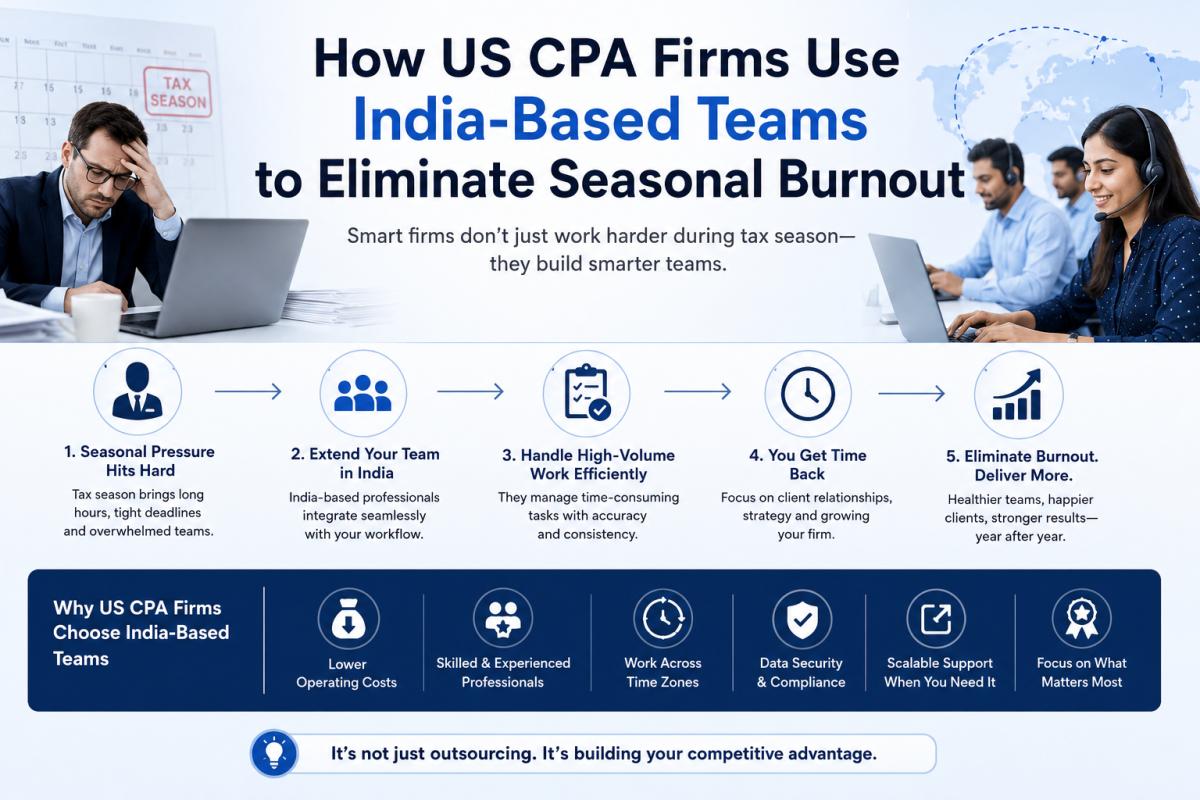
Ask any CPA firm partner what January through April actually feels like, and "burnout" comes up before anything else. Sixty, seventy, sometimes eighty-hour weeks. Senior staff running on coffee and adrenaline. Junior accountants quietly polishing their resumes before May even arrives. Tax season has always been intense—but for a growing number of firms, it's stopped being a seasonal sprint and started being a recurring crisis that costs them their best people every single year.
This is exactly why outsourcing to India has moved from a "nice to have" to a core part of CPA firm capacity building for firms across the U.S. Instead of asking the same small team to survive another brutal season, firms are building offshore accounting teams in India that absorb the seasonal spike before it ever reaches their local staff.
Why Tax Season Burnout Has Become a Structural Problem
Burnout used to be treated as a personal resilience issue — something staff just had to push through. But the numbers tell a different story. The accounting talent shortage means fewer people are available to absorb the seasonal workload in the first place, so the hours that used to be spread across a full team now land on a smaller one.
The result is a predictable, damaging cycle:
| Season | What Happens |
|---|---|
| January – April | Staff work extreme hours to hit filing deadlines, with little room for error |
| May – June | Exhausted junior staff start resigning, taking recent training and client knowledge with them |
| Summer | Firms scramble to rehire and retrain, often at a higher cost than before |
| Fall – Winter | New hires are still ramping up as the next tax season approaches |
| Following January | The cycle repeats, often with an even smaller experienced team than the year before |
Firms that don't break this cycle end up permanently understaffed for their busiest, highest-stakes months — which is exactly why more of them are turning to tax season outsourcing as a long-term fix rather than a one-time patch.
The Real Cost of Seasonal Burnout for CPA Firms
Burnout doesn't just hurt the people experiencing it—it shows up directly on the firm's bottom line and client experience:
Post-season resignations
Junior and mid-level staff frequently leave within weeks of tax season ending, taking client knowledge with them.
Higher error rates under pressure
Fatigued teams make more mistakes on returns and filings, increasing the risk of costly corrections.
Rising recruitment costs
Replacing burned-out staff every year means paying recruiting fees and retraining costs on repeat.
Client experience takes a hit
Overworked teams respond slower and provide less proactive advisory support during peak season.
Partners can't focus on growth
Leadership spends the season firefighting capacity issues instead of building the firm.
Why Traditional Fixes to Seasonal Burnout Fall Short
Most firms have already tried the conventional playbook: hiring seasonal temps, offering overtime pay, or bringing on contract preparers for a few months. These approaches tend to break down in practice:
- Seasonal hires need training every year, since they rarely return, which eats into the time savings they're supposed to provide
- Overtime pay increases costs without actually increasing headcount or capacity
- Contract preparers are in short supply during the exact months every other firm is also trying to hire them
- None of these options address the root problem — there simply aren't enough available accounting professionals locally to go around
This is the gap that outsourced accounting firms based in India are increasingly built to close — not as a stopgap, but as a genuine year-round capacity strategy.
How India-Based Accounting Teams Solve the Seasonal Capacity Problem
India has one of the largest, most experienced pools of accounting and finance talent in the world, with deep familiarity in U.S. tax preparation, bookkeeping outsourcing, and the software American firms already run on. Instead of trying to squeeze more hours out of a shrinking local team, firms extend their capacity through a trained offshore workforce built specifically for this kind of seasonal demand.
| Benefit | How It Helps During Tax Season |
|---|---|
| Instant capacity boost | Trained offshore accountants can be added to your workflow in days, right before peak demand hits |
| No burnout on local staff | Routine prep, data entry, and reconciliations shift offshore, keeping local hours sustainable |
| Overnight turnaround | Work submitted in the evening is completed overnight and ready for review each morning |
| Lower cost than overtime or temps | Offshore staffing typically costs 50–60% less than the fully loaded cost of local overtime or seasonal hires |
| The team stays intact after the season | Because the model isn't exhausting local staff, firms retain more employees year over year |
| Scales down after tax season | Capacity flexes back down once filing deadlines pass, with no long-term overstaffing |
What Tax Season Actually Looks Like With an Offshore Team
Firms that build this model well don't treat their India-based team as a separate vendor — they treat it as a direct extension of their existing staff, working inside the same systems and standard operating procedures. A typical setup during peak season looks like this:
- Tax return preparation handled by offshore staff, with local CPAs reviewing and signing off
- Bookkeeping and reconciliations processed overnight so local staff start each morning with clean books
- Document collection and data entry managed offshore, freeing up local staff for client conversations
- E-filing and compliance checks supported around the clock as deadlines approach
- Local partners and senior staff stay focused on client relationships, complex returns, and advisory work
This is the core idea behind modern outsourced accounting for CPA firms: the client relationship, final review, and professional judgment stay entirely with your firm, while the offshore team absorbs the repetitive, high-volume work that causes burnout in the first place.
Beyond Tax Season: Using Offshore Teams for Year-Round Capacity Building
The firms getting the most value out of this model don't just use it for tax season — they use it as an ongoing CPA firm capacity building strategy. An India-based team can support the following:
- Monthly bookkeeping and reconciliation for retainer clients
- Payroll processing on a predictable weekly or biweekly cycle
- Accounts payable and receivable management
- Financial reporting and month-end close support
- Audit preparation and documentation support
Used this way, offshore staffing stops being a once-a-year emergency measure and becomes a permanent part of how the firm operates — which is exactly why so many US accounting outsourcing partnerships that start with tax season end up expanding into a full hybrid staffing model.
White-Label Accounting Services: Your Brand, Their Capacity
One of the most common questions firms ask before making the switch is whether clients will notice. With white-label accounting services, they don't. Your firm remains the only point of contact for every client—the offshore team works entirely behind the scenes, following your firm's branding, tone, and quality standards. Clients get the same firm they've always worked with; they simply get it without the seasonal slowdown.
Common Questions About Offshore Tax Season Support
Is offshore tax preparation secure?
Reputable providers treat data security as non-negotiable, with NDAs, restricted data access, and internationally recognized certifications like ISO 27001 protecting client information at every step.
Will the quality hold up during high-volume periods?
Established offshore teams are trained specifically on U.S. tax law and the exact software your firm uses, with review layers built into the workflow so nothing reaches a client unchecked.
How fast can a team actually be ready for tax season?
Most firms can have a trained offshore team in place within one to two weeks, which is why many begin the process in the fall rather than waiting until January.
Does this replace our local staff?
No. The goal isn't to replace local CPAs — it's to remove enough of the repetitive workload that your existing team can actually get through tax season without burning out or walking away afterward.
Signs Your Firm Needs This Before Next Tax Season
- Staff regularly work 60+ hour weeks for multiple months in a row
- You lose one or more team members every year shortly after tax season ends
- Senior partners spend peak season on data entry instead of client strategy
- Your firm has had to turn away new clients due to seasonal capacity limits
- Recruiting and retraining costs keep climbing every single year
If even two or three of these sound familiar, it's worth building offshore capacity before the next season starts — not during it.
Final Thoughts
Seasonal burnout isn't a badge of honor in this profession anymore — it's a preventable staffing problem. Firms that keep relying on the same small team to grind through tax season every year will keep losing people, money, and client experience to it. Firms that build offshore accounting teams in India are simply choosing not to have that problem in the first place.
If your firm is heading into another exhausting tax season, building your own offshore accounting team now is the fastest way to change that outcome. Talk to us about what a tax-season-ready team could look like for your firm, or explore our outsourced accounting services to see how it works in practice.
Ready to Scale Your Business?
Connect with our experts to learn how our outsourcing solutions can drive growth.
BOOK A DISCOVERY CALL