 : +1 308-7304-232
 : +44 (744)-139-7094
 : +61 4 8080-3582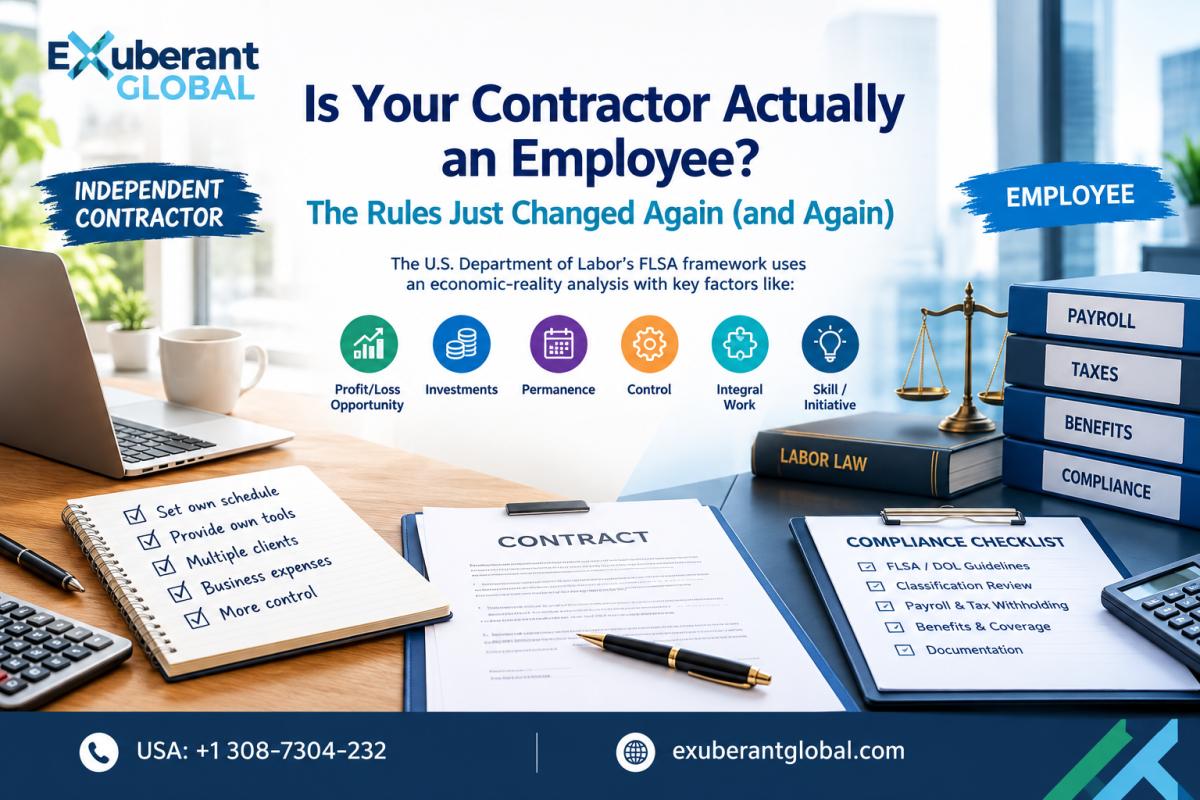
Picture a small marketing agency in Austin. Three years ago, they brought on a graphic designer as a contractor — paid hourly, invoiced monthly, no benefits, no withholding. Reasonable at the time. The designer is still there today, working almost exclusively for that agency, using their software, and attending their Monday standups. Nobody ever revisited the classification, because nothing about the day-to-day felt like it needed revisiting.
Here's the uncomfortable part: that exact working relationship could be read completely differently depending on which federal standard gets applied to it — and right now, in one of the stranger regulatory situations in recent memory, three different standards technically apply at the same time. Not because anyone is confused about the law. Because the law itself is genuinely, simultaneously three things at once.
If your business works with any contractors at all, this is worth actually understanding, not skimming past as background noise. The gap between "how we've always done it" and "how a court or investigator would actually look at it today" has never been wider.
A Rule That's Changed Three Times in Five Years
It helps to walk through this in order, because the sequence itself is the reason things are so tangled right now.
In January 2021, in the final days of the first Trump administration, the Department of Labor published a contractor-friendly rule. It focused narrowly on two things: how much control a business exercised over the work and whether the worker had a genuine opportunity for profit or loss based on their own decisions. Simple, two-factor, and relatively easy to apply.
Three years later, in January 2024, the Biden administration's DOL threw that out and replaced it with something much broader — a six-factor "totality of the circumstances" test that weighed everything from investment in equipment to how integrated the worker was into the business's operations. It leaned, by design, toward finding employee status more often than the 2021 version had.
Then, in May 2025, something unusual happened. The current DOL didn't repeal the 2024 rule — it just stopped enforcing it. A Field Assistance Bulletin quietly instructed field investigators to set the 2024 standard aside and go back to using guidance from 2008, plus a reinstated opinion letter from 2019. The 2024 rule stayed on the books as written law. It just stopped being the thing DOL agents actually apply when they show up to investigate a business.
And then, this past February, the DOL proposed yet another new rule — one that closely resembles the 2021 standard, built again around those same two core factors, with a handful of secondary considerations layered in. As of right now, that proposal is sitting at the White House for review. It hasn't taken effect. It isn't law yet.
So here's where that leaves an actual business trying to classify an actual worker today: the 2024 rule is still technically what's written into federal regulation. The DOL itself has told its own investigators not to use it. And a new rule that would replace it entirely hasn't been finalized. Three standards, all live in some sense, none of them fully in charge.
Why This Isn't Just a Technicality
It would be easy to read all of that and conclude it doesn't really matter — that if DOL isn't enforcing the strict 2024 rule, a business is effectively safe using the looser, older standard instead. That conclusion would be wrong, and it's the single most important thing to understand about this entire situation.
DOL's enforcement posture only controls what DOL itself investigates and acts on. It has no bearing on private lawsuits. A worker who believes they were misclassified — the graphic designer in Austin, say, after a falling-out or a layoff — can still sue under the 2024 rule's more employee-friendly standard, entirely independent of whatever DOL happens to be doing at the moment. The agency's non-enforcement doesn't close that door. It just means the government itself isn't the one most likely to knock on it right now.
There's a second layer to this too, one that's easy to forget entirely: none of this is purely federal. State law sits on top of whatever the federal standard says, and several states — California's ABC test being the best-known example — apply a considerably stricter bar than any version of the federal rule currently in play. A worker classification that would survive scrutiny under the loosest federal reading can still fail outright under a state's own test, and generally, the stricter standard is the one that governs.
| Where Things Actually Stand | What It Means in Practice |
|---|---|
| The 2024 rule | Still the technically written federal law, still usable in private litigation |
| DOL's current enforcement | Uses older, looser 2008/2019 guidance instead — but only governs DOL's own investigations |
| The February 2026 proposed rule | Would replace the 2024 standard but remains under review, not yet in effect |
| State classification laws | Operate independently of federal rules, and several are stricter than any federal version |
What Getting It Wrong Actually Costs
Misclassification exposure tends to get underestimated because people imagine it as a single fine. It's rarely that contained. Back wages for unpaid overtime the worker should have received as an employee. Retroactive unemployment insurance contributions. Workers' compensation coverage gaps if the misclassified worker was ever injured on the job. Benefits — health insurance, retirement contributions — that an employee would have been owed and a contractor wasn't. And that's before state-level penalties, which in some states are calculated per worker, per pay period, and add up considerably faster than a single lump-sum fine would.
None of that requires bad intent. A business that classified a worker reasonably under the 2021 standard, never revisited the decision, and gets challenged under the 2024 standard a few years later isn't dealing with a case of obvious wrongdoing — it's dealing with the ordinary cost of a classification that was never updated as the ground underneath it kept shifting.
So What Should a Business Actually Do Right Now?
Not panic, and not overcorrect. Reclassifying every contractor as an employee out of caution creates its own cost and complexity, and it's rarely the right move for roles that are genuinely, legitimately independent. The more useful response is quieter and more durable: build an actual paper trail.
For every contractor relationship currently in place, it's worth documenting — in writing, dated, and kept on file — the actual reasoning behind the classification. How much control does the business really exercise over how, when, and where the work gets done? Does the worker have a genuine opportunity for profit or loss tied to their own business decisions, or are they economically dependent on this one relationship in a way that looks more like employment? What does the specific state's test say, not just the federal one? None of these questions are new, but answering them once, in writing, today, is very different from having never answered them at all.
That documentation matters for a simple reason: if a classification is ever challenged—by DOL, by a state agency, or by the worker directly—the question won't just be "was this the right call?" It'll be "Did this business make a reasoned, good-faith determination, or did it just default to whatever was administratively convenient?" A dated file with real reasoning behind it is the difference between those two answers.
The DOL's own standard has shifted three times in five years, and a fourth version is already in the pipeline. A classification decision made once and never revisited isn't a small oversight anymore — it's exactly the kind of gap that surfaces during an audit or a former contractor's lawsuit, years after the decision felt obvious.
Where the Bookkeeping Actually Lives in All This
It's worth being precise about where a bookkeeper or payroll provider fits into this picture, because classification itself isn't a call they should be making. That determination belongs with your accountant or employment counsel, weighing the actual facts of the relationship against the standards above. What a payroll function can and should own is everything downstream of that decision: keeping 1099 and W-2 workers tracked distinctly and consistently, making sure payroll runs and tax filings actually match the classification on record, and catching it quickly if a contractor relationship has quietly drifted — more hours, more control, more integration — toward something that looks more like employment than it did when the classification was first made.
That's precisely the kind of ongoing, detail-heavy consistency an outsourced payroll team is built to maintain, especially while the underlying federal standard itself is still this unsettled — keeping the paperwork honest even when the rules it's built on keep moving underneath it.
Questions Worth Asking Before You Assume You're Fine
Is the 2024 rule dead now that a new one has been proposed? Not yet, and this is the detail people get wrong most often. It remains the written federal law until the 2026 proposal completes the full rulemaking process and formally takes effect, which hasn't happened.
If DOL isn't enforcing the 2024 rule, are we safe relying on the older, looser standard? Only partially. That non-enforcement limits DOL's own investigations specifically. It does nothing to limit a worker's ability to bring a private lawsuit under the stricter 2024 standard, regardless of what DOL itself is currently willing to act on.
Does federal law override what our state says about classification? No, and this trips up more businesses than the federal back-and-forth does. State classification laws operate independently; several are meaningfully stricter than any current federal standard, and the stricter of the two generally governs in that state.
When will the 2026 proposed rule actually become final? It's currently under White House review, with a public comment period and additional procedural steps typically still ahead before a proposed rule becomes enforceable law — there's no confirmed effective date yet.
Should we wait for the dust to settle before reviewing our contractor classifications? No. Since private litigation can invoke the current 2024 standard regardless of what happens next, the exposure exists today, not after a new rule is finalized — which is exactly why the documentation is worth doing now rather than later.
The Bottom Line
Worker classification used to be the kind of decision a business made once, filed away, and never thought about again. That's no longer a safe way to treat it. With three different standards technically live at once — written law, actual enforcement practice, and a proposed rule still working its way through review — the businesses in the best position aren't the ones that guessed correctly. They're the ones that can actually show their work.
Ready to Scale Your Business?
Connect with our experts to learn how our outsourcing solutions can drive growth.
BOOK A DISCOVERY CALL