 : +1 308-7304-232
 : +44 (744)-139-7094
 : +61 4 8080-3582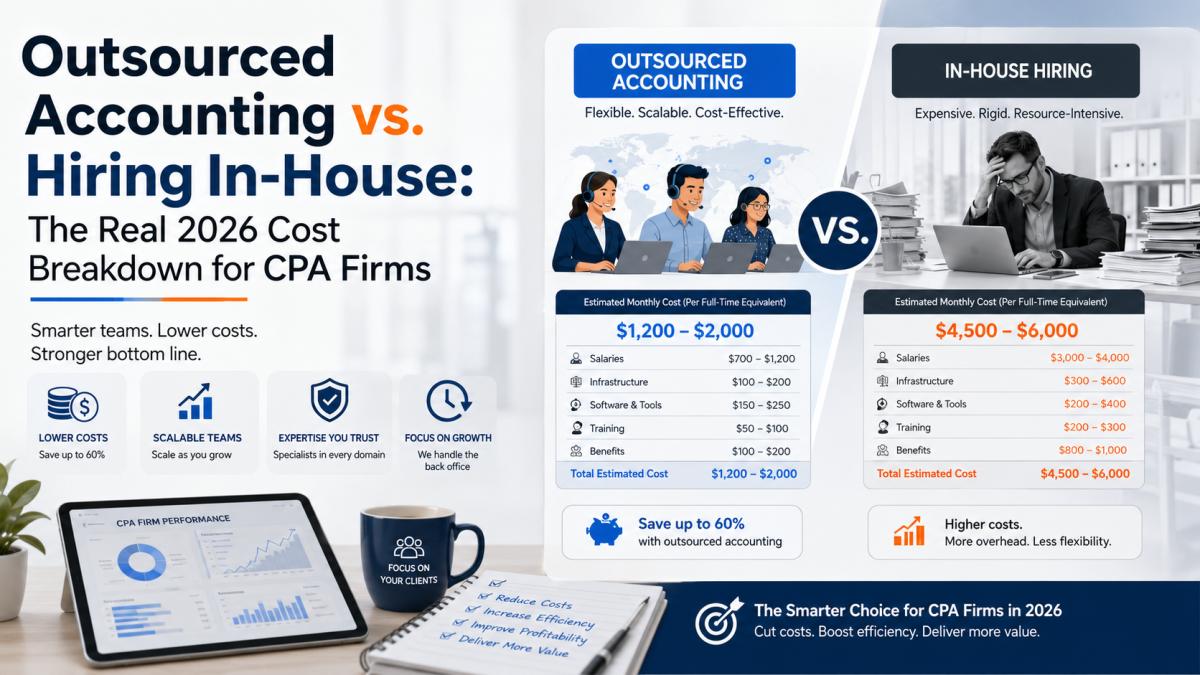
Outsourced Accounting vs. Hiring In-House: The Real 2026 Cost Breakdown for CPA Firms
Every CPA firm partner eventually has this conversation with themselves, usually around 11 p.m. after a long close: "Do I hire someone else, or do I finally look into outsourcing?"
It's not a fun decision. Hiring feels safer — you know the person, they sit down the hall, you can walk over and ask a question. Outsourcing feels like a leap — a stranger on a screen, a different time zone, a leap of faith on quality. So most firms default to what's familiar. They post the job, they interview for three months, they make an offer, and they quietly hope the new hire sticks around longer than the last one did.
Here's the uncomfortable part: that "safe" choice is usually the more expensive one, and most firms don't realize by how much until they actually sit down and do the math. So let's do the math.
The Salary Number Is a Trap
If you ask a managing partner what it costs to hire a staff accountant, they'll usually quote you a salary. Maybe $60,000. Maybe $70,000 for someone with a couple years of experience. That number feels manageable. It's also badly incomplete.
A fully loaded employee costs meaningfully more than their salary line — and the gap tends to run 40 to 60% once you stack on everything that comes with putting someone on payroll. Here's what actually gets added on top of that quoted salary:
- Payroll taxes. Employer-side FICA, unemployment insurance, and state-specific payroll taxes — this alone typically adds several thousand dollars per employee before anything else.
- Health insurance. Group premiums for a single employee commonly run in the $7,000–$14,000 range annually, and most firms are covering somewhere between half and most of that.
- Retirement contributions. A competitive 401(k) match in 2026 usually means budgeting another 3–4% of salary, because if you don't offer it, the person down the street will.
- Recruiting and onboarding. Job postings, recruiter fees, the hours partners and managers spend interviewing, and the ramp-up period where a new hire is being paid full salary while still learning your systems — this alone can run several thousand dollars per hire before they've done a single billable hour of real work.
- Turnover risk. Public accounting has a well-documented turnover problem, and every time someone leaves within two or three years, you're paying the recruiting and ramp-up cost all over again.
Add it up, and a $60,000 staff accountant is often closer to a $90,000–$100,000 true cost. A senior accountant or tax preparer quoted around $95,000 can land closer to $115,000–$130,000 once everything is loaded in. None of this is a hidden conspiracy — it's just math that doesn't show up on the offer letter.
Here's what that stacks up to, roughly, for a $60,000 staff-level hire:
That's roughly 50–65% more than the number on the offer letter — before you've factored in a single sick day, a slow ramp-up month, or the cost of doing this all over again if the hire doesn't work out.
What Outsourcing Actually Costs in 2026
Now put that next to what a comparable outsourced arrangement costs.
For small and mid-sized engagements, full-service outsourced accounting commonly runs somewhere in the range of $1,500–$3,500 a month — call it $18,000–$42,000 a year for a full engagement, though plenty of firms pay less depending on scope. For more specific functions, the gap gets even starker: outsourced accounts payable work that would cost $45,000–$60,000 a year in-house can often be handled by a dedicated offshore AP specialist for somewhere around $15,000–$20,000. Outsourced tax return preparation, priced per return, frequently comes in at a fraction of what an in-house preparer's fully loaded cost works out to per return during peak season.
Look across enough of these comparisons and a pattern shows up again and again: outsourcing tends to land somewhere between 40% and 80% cheaper than the fully loaded cost of an equivalent in-house hire, depending on the role and how it's structured.
That's not a rounding error. That's the difference between a hire that quietly drags on your margin every single month and a flexible line item that scales up during busy season and back down when things slow.
In-House vs. Outsourced: The Numbers Side by Side
These are directional ranges, not quotes — your actual numbers will depend on your market, the role's complexity, and how the engagement is scoped. But the pattern holds across almost every function: the gap is rarely small.
But Cost Isn't the Whole Story — And It Shouldn't Be
Here's where I'd push back a little on the "just look at the savings" pitch you'll see in a lot of outsourcing marketing. Cost is a real advantage, but it's not the only thing that matters, and firms that outsource purely to chase the cheapest number sometimes get burned on quality or communication. A more honest way to frame the decision is around a few practical questions:
How steady is the workload, really? If you need someone doing meaningful accounting work every single day, month after month, an in-house hire's fixed cost starts to make more sense on a per-hour basis — you're using the capacity you're paying for. If the workload spikes at month-end, quarter-end, or tax season and goes quiet in between, you're paying full-time overhead for part-time need, and that's exactly where outsourcing tends to win.
How hard is this role to hire for locally? Staff-level bookkeeping and transaction-level work tends to be both the easiest to outsource and the hardest to keep staffed domestically right now — accounting graduate numbers have been declining for years, and competition for the people who are out there is fierce. Meanwhile, client-facing advisory roles and final technical review are usually worth keeping in-house, because that's where the relationship and the judgment calls live.
What's your actual risk tolerance for a bad quarter? A bad in-house hire costs you a slow ramp-up and possibly a rehire. A bad outsourcing relationship costs you a contract you can typically exit faster than you can manage out an employee. Neither is risk-free, but the downside shape is different, and it's worth being honest with yourself about which one you're more equipped to manage.
Quick Decision Snapshot
A Grounded Way to Think About It
If I were advising a firm partner on this instead of writing a blog post about it, here's roughly what I'd say:
Don't try to outsource everything at once, and don't try to replace every hire with an outsourced version out of the gate. Start with the function that's both the most expensive to staff domestically and the most outsourcing-friendly — usually staff-level bookkeeping, transaction processing, or accounts payable. Run it with a small outsourced team for a quarter or two. Watch the quality, watch the communication, watch how it actually feels day to day. If it holds up, expand from there. If it doesn't, you've learned something for the cost of a trial, not a bad hire.
Keep your client relationships and your final review in-house. That's not just a nice sentiment — it's where the real value of your firm's judgment shows up, and it's the layer clients are actually paying you for.
And run the real numbers before you decide anything. Not the salary line — the fully loaded number, side by side with what a comparable outsourced arrangement would actually cost for your specific team size and workload. Most firms are surprised by what they find, in both directions — sometimes outsourcing is the obvious win, and sometimes a well-timed in-house hire genuinely is the smarter call. You won't know which one you're looking at until you do the math for your own firm instead of relying on someone else's averages.
The Bottom Line
The old assumption — that hiring in-house is the "safe, quality" choice and outsourcing is the "cheap, risky" one — doesn't hold up as well as it used to. In 2026, outsourced accounting providers have gotten more sophisticated, better resourced, and often better equipped with AI-assisted tools than a lot of in-house teams are. The savings are real, often substantial, and the quality gap that used to justify paying a premium for in-house work has narrowed considerably for the roles most firms are actually trying to fill.
That doesn't mean outsourcing is right for every function or every firm. But it does mean the decision deserves an actual cost comparison, done honestly, rather than a gut call based on what feels more comfortable.
If you want that comparison done for your specific team size and workload rather than relying on industry averages, Exuberant Global builds custom outsourced accounting models for CPA firms based on their actual staffing needs. You can see how it works at exuberantglobal.com.
Ready to Scale Your Business?
Connect with our experts to learn how our outsourcing solutions can drive growth.
BOOK A DISCOVERY CALL