 : +1 308-7304-232
 : +44 (744)-139-7094
 : +61 4 8080-3582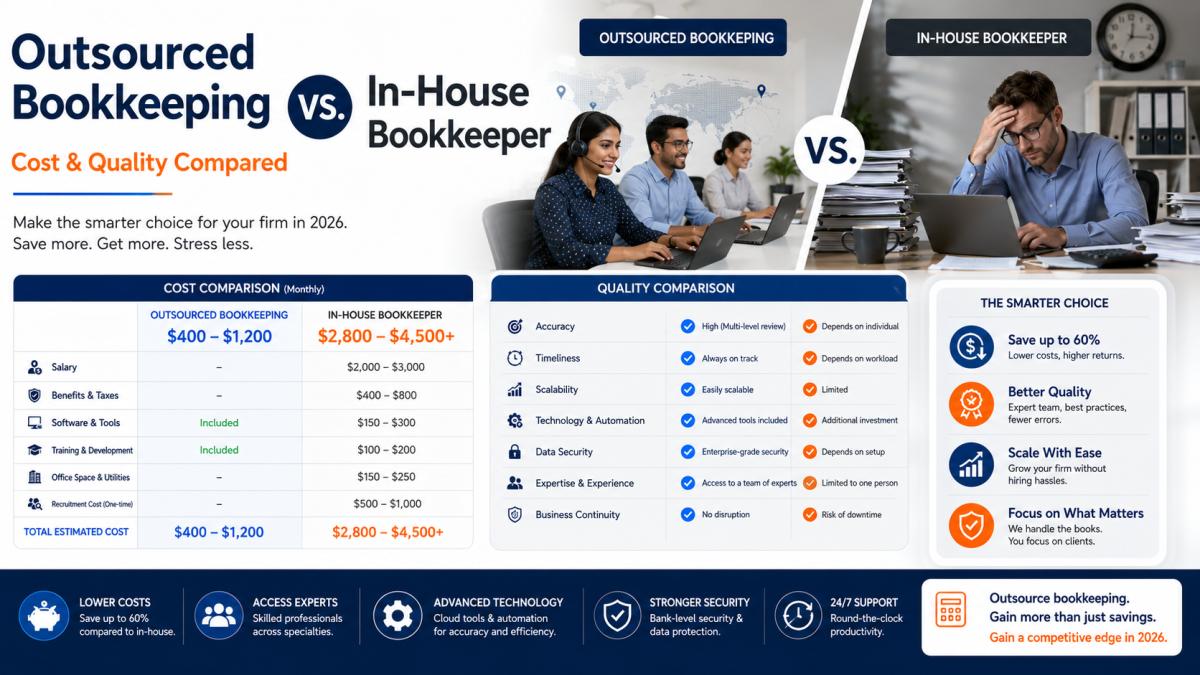
Outsourced Bookkeeping vs. In-House Bookkeeper: Cost & Quality Compared
At some point, every growing business hits the same wall: the spreadsheet isn't cutting it anymore, and someone needs to actually own the books. Invoices are slipping through the cracks. Reconciliations pile up. Tax season arrives and nobody can say with confidence what the real numbers are. The instinct at this point is almost always the same — hire someone. Post a job, interview a few candidates, bring someone on, problem solved.
But that instinct skips a question worth asking first: is hiring actually the best way to solve this problem, or just the most familiar one? For a lot of businesses, the honest answer is that hiring is a habit, not a strategy. There's another option that's grown dramatically over the past few years, matured in quality, and now genuinely competes with — and often beats — the in-house model on both cost and reliability: outsourced bookkeeping.
This isn't a simple "outsourcing is always cheaper, so do that" argument. Both paths have real trade-offs. Let's walk through what each one actually costs, where the quality differences genuinely show up, and how to figure out which one fits your business as it exists today — not the business you might have in three years.
What a Bookkeeper Actually Does (And Why This Matters for the Comparison)
Before comparing costs, it's worth being precise about what's actually being compared. Bookkeeping typically covers transaction categorization, bank and credit card reconciliations, accounts payable and receivable tracking, payroll support, monthly financial statement preparation, and keeping your books audit-ready and tax-season-ready. It is not the same as tax filing or high-level financial strategy — those are usually separate functions, whether in-house or outsourced.
The reason this matters is that both an in-house bookkeeper and an outsourced bookkeeping service are, in theory, delivering the same list of tasks. The differences that matter aren't in what gets done — they're in how consistently it gets done, how quickly, and at what real cost.
What an In-House Bookkeeper Actually Costs
A bookkeeper's salary is only part of the bill, and it's the part most business owners budget around — which is exactly the problem. Once you add payroll taxes, benefits, software licenses, a workstation, and the time spent recruiting and training, the real cost climbs well above the number on the offer letter, typically by 40–60%.
Here's a realistic breakdown for a single full-time, in-house bookkeeper earning a base salary in the $45,000–$55,000 range, which is fairly typical for this role in most U.S. markets:
| Cost Component | Typical Annual Amount |
|---|---|
| Base salary (bookkeeper) | $45,000 – $55,000 |
| Payroll taxes & benefits | $10,000 – $15,000 |
| Software & workstation | $1,500 – $3,000 |
| Recruiting & onboarding (amortized) | $2,000 – $4,000 |
| Fully loaded true cost | $60,000 – $75,000/yr |
Beyond the direct dollar cost, there are softer costs that rarely make it onto a spreadsheet but affect the business just as much. There's the management time a business owner or office manager spends supervising the bookkeeper's work, especially in the first few months. There's the risk of a skills gap — a bookkeeper hired for basic transaction entry may not have the depth to handle a multi-entity structure, inventory accounting, or a messy backlog of unreconciled accounts. And there's turnover: when a bookkeeper leaves, the business isn't just short-staffed, it often loses institutional knowledge about how specific vendors, clients, or account structures were historically handled.
What Outsourced Bookkeeping Actually Costs
Outsourced bookkeeping pricing generally scales with transaction volume and complexity rather than a flat salary. For small and mid-sized businesses, full-service outsourced bookkeeping commonly runs $1,500–$3,500 a month — roughly $18,000 to $42,000 a year. Simpler books with lower transaction volume can run even lower, sometimes in the $500–$1,200 monthly range for very small operations.
Unlike a salary, this cost typically scales down during slow periods and up during growth, without the friction of a hiring or layoff decision. Many providers also offer tiered service levels, so a business can start with basic transaction categorization and reconciliation, then add payroll support, AP/AR management, or monthly financial reporting as needed.
Side-by-Side: Annual Cost and Practical Differences
| Factor | In-House Bookkeeper | Outsourced Bookkeeping |
|---|---|---|
| Annual cost | $60,000 – $75,000 | $18,000 – $42,000 |
| Backup coverage | None if they're out sick or leave | Team-based, rarely a single point of failure |
| Specialized expertise | Limited to that one person's experience | Access to a wider bench of specialists |
| Scalability | Requires a new hire to scale up | Scales with transaction volume |
| Onboarding time | 4–8 weeks to find and train | Often 1–3 weeks to full productivity |
| Day-to-day accessibility | In the building, immediate answers | Usually same-day, not always instant |
Where Quality Actually Differs
This is the part cost tables can't fully capture, and it's often where business owners get the comparison wrong in either direction. In-house wins on immediacy — someone is physically there, and for businesses that need constant, real-time back-and-forth about invoices or cash flow, that's genuinely valuable. If your business runs on same-hour decisions about vendor payments or has a bookkeeper who's deeply embedded in daily operations, that presence has real value that's hard to replicate remotely.
But quality isn't automatically higher in-house, and this is the part that surprises a lot of business owners. A single bookkeeper is one person's skill level, one person's attention on any given day, and one person's absence away from a gap in your books. If they're sick, on vacation, or simply have an off week, there's no safety net catching mistakes before they compound. Outsourced providers built specifically around accounting work usually run reviewed, multi-person workflows — someone processes the transactions, someone else checks the work before it's finalized. That built-in review layer catches errors a solo in-house bookkeeper has no one to catch for them.
There's also a specialization advantage on the outsourced side that's easy to underestimate. An in-house hire is exactly as good as their individual background — if they've never handled inventory-heavy businesses, multi-entity structures, or industry-specific accounting quirks, you're stuck with that gap until you either train them extensively or hire someone new. A well-established outsourced provider typically has staff who've seen a much wider range of business types and can bring in more specialized expertise as your needs get more complex, without you needing to go through another hiring cycle.
The trade-off is communication style. In-house is a hallway conversation — quick, informal, immediate. Outsourced is usually a scheduled call, a shared portal, or a messaging thread — slightly less spontaneous, but often more documented and structured, which has its own value when you need a clear paper trail of decisions later.
A Few Real-World Scenarios
The early-stage startup with simple books. Low transaction volume, a handful of vendors, straightforward revenue. Here, a full-time in-house bookkeeper is almost always overkill — you'd be paying a full salary for maybe 10–15 hours a week of actual work. Outsourced bookkeeping, often at the lower end of the pricing scale, fits this stage far better.
The growing business with 50–200 transactions a month. This is where the comparison gets genuinely close. A part-time or full-time in-house bookkeeper starts to make more sense if the owner values daily, in-person availability. But most businesses at this stage are still better served by a mid-tier outsourced engagement, which can flex up during a busy month without the business needing to hire a second person.
The business with complex, high-volume, or multi-entity books. At this scale, either option can work well, but the deciding factor tends to be less about cost and more about how much oversight and embedded knowledge the business needs. Some businesses at this stage build a hybrid model — an in-house controller or office manager overseeing an outsourced bookkeeping team that handles the transaction-level work. This combines the presence and judgment of an in-house role with the cost efficiency and backup coverage of outsourcing.
Common Myths, Addressed Directly
"Outsourced bookkeepers won't understand my business." This depends entirely on the provider, not on outsourcing as a concept. A provider with experience in your industry and a proper onboarding process to learn your chart of accounts, vendors, and business quirks will understand your books just as well as an in-house hire would after a similar ramp-up period.
"In-house is always more secure." Security depends on practices, not location. A reputable outsourced provider with strong data controls, encryption, and access restrictions can be considerably more secure than an in-house setup with no formal security protocols at all — which is more common than business owners realize.
"Outsourcing means losing control of my books." A well-run outsourced relationship should give you more visibility, not less — regular reports, a clear audit trail, and defined sign-off points. Losing control is usually a sign of a poorly structured engagement, not an inherent feature of outsourcing.
Questions to Ask Yourself Before Deciding
How many hours of actual bookkeeping work does your business generate in a typical week? Does your business need someone physically present to hand documents to or ask quick questions of throughout the day? How much would a gap in coverage — a sick day, a vacation, a resignation — actually cost you if your books fell behind for two or three weeks? And honestly: is your current instinct to hire based on real analysis, or just because that's what's always been done?
The Bottom Line
The safe-feeling choice isn't always the better one, and the cheaper choice isn't automatically the riskier one. Both in-house and outsourced bookkeeping can work well — the right answer depends on your transaction volume, how much in-person presence your business genuinely needs, and how much you value built-in backup coverage over daily physical access. Before deciding, run the actual numbers for your specific transaction volume — not the salary line, the fully loaded one, side by side with a real outsourced quote for your business size. Most business owners are surprised by what they find once they do the math honestly instead of relying on assumptions.
Ready to Scale Your Business?
Connect with our experts to learn how our outsourcing solutions can drive growth.
BOOK A DISCOVERY CALL