 : +1 308-7304-232
 : +44 (744)-139-7094
 : +61 4 8080-3582
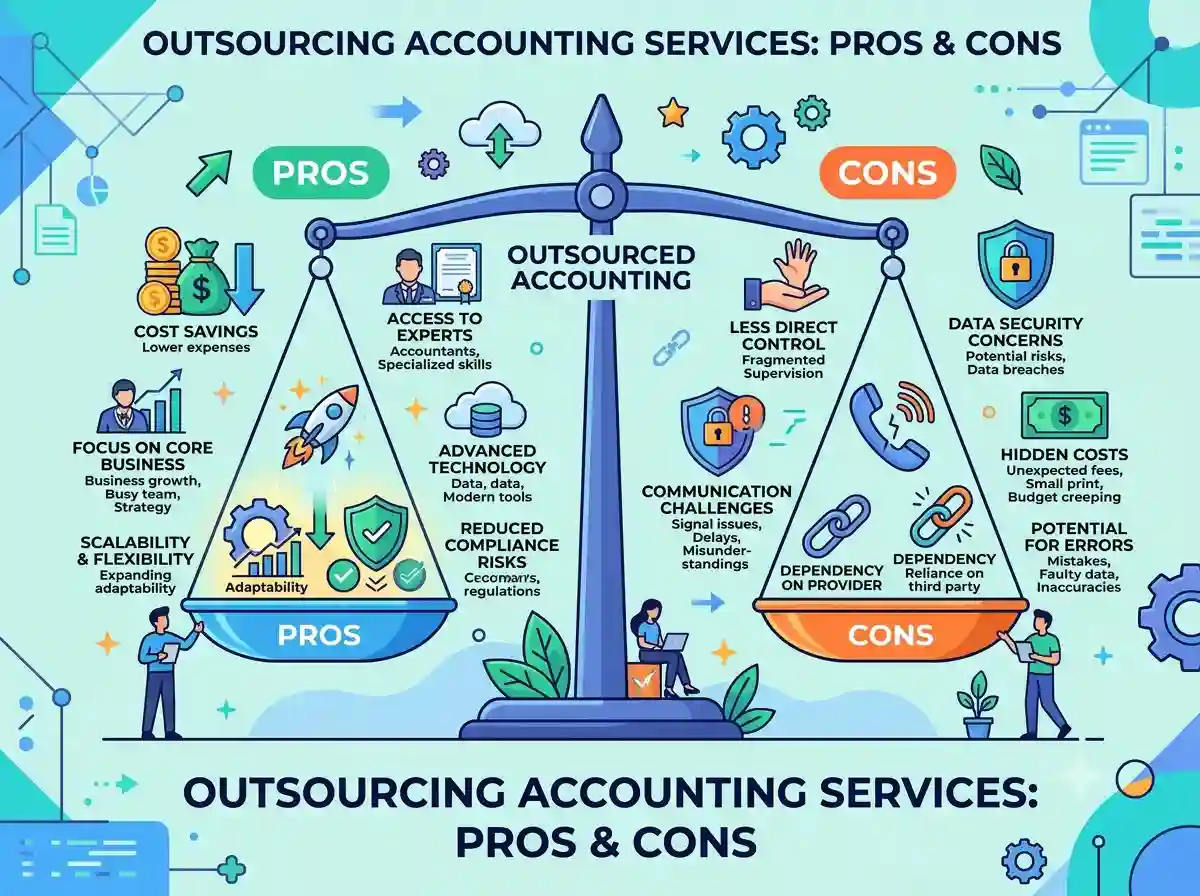
The Strategic Blueprint: Weighing the Pros and Cons of Outsourcing Your Accounting Services
For a growing business the accounting will eventually hit a critical point. In the early days a founder will probably be doing their own invoicing and expense tracking in a spreadsheet or some basic accounting software. As the volume of transactions increases, payroll gets bigger and tax compliance becomes more complex and the accounting becomes a massive time sink.
When that happens business leaders are faced with a very fundamental operational decision: do you go in and recruit, onboard and retain an in-house finance team or do you simply hand the whole thing over to an external specialist?
Outsourcing your accounting is a very effective way of cutting your overheads and getting access to a very high quality of financial expertise. It's a route that comes with its own set of issues in terms of reduced control over the operation and potential communication problems. The decision of whether or not to go down that route is one that you need to make based on an honest assessment of your current volume of business, your future growth plans and your own level of comfort with working with an external partner.
Part 1: The Core Mechanisms of Outsourced Accounting
To get a proper sense of the trade-offs it's useful to understand what modern outsourced accounting actually is. It's no longer simply a remote data entry clerk processing paper receipts once a month. It's now a flexible, tech-enabled environment.
External financial management generally falls into three distinct tiers:
Transactional bookkeeping: the day to day management of accounts payable, accounts receivable, bank reconciliations and payroll.
Managerial Accounting: preparation of monthly financial statements, balance sheets, cash flow trend analysis and management reports.
Strategic Fractional CFO Services: strategic financial forecasting, capital allocation, fundraising preparation and in-depth tax planning.
By using cloud based ecosystems the outsourced companies are effectively embedded into your working process. They use the automated tools to get a real time view of your cash flow and can therefore provide you with the financial insight you require without the need for a desk in the office.
Part 2: The Advantages of Outsourcing Accounting
THE ADVANTAGES AT A GLANCE
Financial Efficiency Operational Power
• Lower overhead costs • Instant, plug-and-play scaling
• Zero employee benefits to pay • Specialized expert insight
• Minimized software expenses • Strict internal fraud checks
1. Significant, measurable cost savings
The most obvious reason for moving to external financial management is financial efficiency. The cost of employing a full time, experienced internal accountant is a significant expense and runs well beyond just the basic salary.
When you hire internally, you are fully responsible for:
- Recruitment fees and onboarding downtime
- Employer-paid payroll taxes and retirement contributions
- Health insurance premiums and paid time off
- Physical office space, hardware, and dedicated software licenses
Outsourcing turns those big, fixed structural costs into a series of predictable, variable monthly costs. You only pay for the amount of work you actually require. A small business may only need 15 hours of bookkeeping support per month and it would be incredibly inefficient to have a full time employee on the payroll to provide 40 hours a week.
2. Immediate access to high level expertise
Financial management is a completely different ball game at different stages of growth. A bookkeeper who is absolutely brilliant at sorting through receipts is going to be utterly lost when you ask them to deal with the intricacies of state by state sales tax, R&D tax credits or the construction of a forecast for a VC pitch.
Outsourcing deals with the skills gap by giving you access to a whole team of financial professionals. Rather than having to rely on a single generalist, you have access to a team comprising bookkeepers, controllers and CPAs. The result is that the day to day work is done at a very low cost and any more complex issues are simply escalated to the appropriate senior professional.
3. Built-in fraud prevention and internal oversight
Internal financial fraud is a quiet but very serious threat to SMEs. If one individual is responsible for the entire financial cycle (writing the cheques, doing the bank reconciliations, updating the ledgers etc) then there is no real oversight and that is a very serious vulnerability.
Outsourcing creates an instant system of checks and balances. The transactions are processed by an independent third party so it's very difficult indeed for the internal staff to fiddle the records or skim off the top. The reputable agencies will also have a very strict system of segregation of duties in their own teams with the person entering the invoice being a completely different person to the person who then approves the payment.
4. Seamless Scalability
Hiring an in-house team invariably leads you into a situation where you're either massively overstaffed or massively understaffed. If you have a sudden surge in sales or you launch a new product line then one individual internal accountant can very quickly get buried under the load and you end up with delayed reports and data errors of a very serious nature.
External providers scale with your business as and when required. If your transaction volume doubles in a single quarter the provider simply puts more resources into your account. You don't have to go through the hassle of putting out job ads, interviewing and onboarding new staff during a period of significant growth.
Part 3: The Drawbacks and Risks of Outsourcing
The benefits are all very well but outsourcing is by no means a perfect solution. It does present you with certain operational issues which can cause problems for your business if you don't plan for them adequately.
1. The loss of instant, on-site access
In an in-house scenario, proximity is a definite advantage. If a vendor rings and wants an immediate update on a payment, you can just walk down the corridor, get the answer in 30 seconds and deal with it straight away.
Outsourcing completely changes the game. You're working within their operational model and their ticketing system. Even the most responsive agencies will have SLAs in place so you may well be looking at a few hours or indeed the next day to get answers to ad hoc questions. For a company that operates at speed and expects instant answers it can be a real shock to have to make that adjustment.
2. Exposure to scope creep and unexpected costs
Outsourcing can be extremely cost effective but you have to read the small print. The majority of the external firms you will deal with will provide you with a proposal based on a set of assumptions. These will typically be around a certain number of transactions per month, a certain number of bank accounts to reconcile and a certain set of financial statements.
If your business reality changes, costs can go up very quickly. Common reasons for unexpected charges would be:
- Adding new sales platforms or corporate credit cards
- Requesting custom, ad-hoc reports for investors
- Needing cleanup work for poorly organized historical data
- Requiring extensive phone consultations outside of scheduled monthly check-ins
No clear boundaries in your original agreement means that your fairly predictable monthly fee could be inflated by a whole host of expensive hourly add ons.
3. Data Security and Confidentiality Risks
Your most sensitive financial data is now being entrusted to an external vendor and that in itself vastly increases your attack surface from a cyber security perspective. In order to do their job they're going to need deep access to your business bank accounts, your payroll systems, your tax IDs and your vendor invoices.
If the providers are using weak password protocols, accessing your data over unsecure networks or using out of date software then your business could be open to data breaches and/or phishing. A proper assessment of the provider's security posture is a must, not a nice to have.
4. A disconnect from your daily company culture
An internal finance person is absolutely alive to your company's mission. They know the stories behind the numbers, who the vendors are that need a soft touch, who the clients are that will always be late but are absolutely vital to the business, and how the day to day running of the floor affects the cash flow.
An external agency by definition is going to look at your business from a fairly objective perspective. The data they produce will be clean, that's for sure. The downside of that objectivity is that it can be a bit cold at times. They'll be looking at line items and variances, they may not have the same level of insight into your strategic direction or the actual nature of your customer relationships.
Part 4: In house vs outsourced accounting
Choosing the right path is about looking at the two models side by side in terms of the key business priorities.
| Feature | In-House Accounting Team | Outsourced Accounting Services |
| Availability | Instant, daily face-to-face access during office hours. | Structured communication via email, phone, and video calls. |
| Cost Predictability | Fixed salary and benefits costs, regardless of business volume. | Flexible monthly fees that adjust based on transaction volume. |
| Breadth of Skill | Limited to the specific skills of the individuals hired. | Broad access to specialized bookkeeping, controller, and CPA talent. |
| Software Management | The business must buy, configure, and update all systems. | The provider manages and maintains advanced software tools. |
| Backup Coverage | Vulnerable to disruptions when staff take sick leave or resign. | Consistent coverage backed by an entire team of professionals. |
Part 5: Is outsourcing the right move for your business?
There's no single answer to this. It will depend very much on where you are in your growth phase, what your operational complexity is and what you prefer in terms of management.
When to Keep Your Accounting In-House
Having an in-house team is the most sensible approach if you're running a very complex organisation with highly specialised inventory management, very specific compliance requirements or proprietary transactional processes that need to be monitored on a continuous, real time basis.
If your leadership style is all about getting together at the moment and you really do want to keep all the operational data in your office (i.e, your own office) then going down the route of an internal department is the way to go.
When to Outsource Your Accounting
Outsourcing is ideal for small to mid-sized businesses, professional services firms, e-commerce businesses and fast growing startups who want to focus their efforts on product development and customer acquisition rather than on the admin.
If your real objective is to get rid of all the unnecessary overhead, to have a clear view of your finances and to build a framework that can scale without you having to hire a single person to do it, then outsourcing is the way to go.
Frequently Asked Questions
How do outsourced accountants access my banking systems safely?
Modern accounting firms use secure, read-only access provisions for your banking institutions. This configuration allows them to view transaction histories and download bank statements to complete reconciliations, but prevents them from moving money, approving wires, or transferring funds out of your accounts. Any actual cash movements remain firmly in your hands.
What happens if the outsourced firm makes a costly error on my taxes or financial reports?
Your service agreement should explicitly outline liability boundaries and errors-and-omissions (E&O) insurance coverage. Reputable accounting firms carry extensive professional liability insurance to cover financial damages resulting from direct processing mistakes. However, you remain responsible for providing honest, accurate source documentation; an agency cannot be held liable if they base their work on incomplete or falsified records provided by your team.
Will I lose access to my own financial information?
Not at all. Professional outsourced providers work within cloud-based systems like QuickBooks Online, Xero, or Sage Intacct. The master administrative rights to these accounts belong to your business. The agency is granted user access to perform their duties, meaning you can log in at any moment, from any location, to view your financial statements in real time.
How do we handle daily tasks like paying invoices and processing payroll?
Most providers build a structured, digital approval workflow. For instance, when a vendor sends an invoice, your team uploads it to a secure portal (like Bill.com). The outsourced accountant codes the invoice, verifies it against your purchase orders, and schedules the payment. The payout then sits in a digital queue until you, the business owner, review it and click "approve" to release the funds.
How long does it typically take to transition to an outsourced model?
A standard onboarding period takes anywhere from 30 to 60 days, depending on the current state of your books. The first month focuses heavily on mapping your chart of accounts, migrating data to the cloud, establishing secure software integrations, and documenting your specific operational workflows. If your historical records require extensive cleanup, this initial setup phase may take a bit longer.
Can I outsource just my bookkeeping and hire a separate CPA for year-end taxes?
Yes, this hybrid approach is highly common. You can hire an outsourced bookkeeping firm to keep your records immaculate and organized on a monthly basis. When tax season arrives, your bookkeeper can hand over a clean, fully reconciled set of books directly to your preferred tax CPA, saving you from expensive hourly cleanup fees at the end of the year.
Ready to Scale Your Business?
Connect with our experts to learn how our outsourcing solutions can drive growth.
BOOK A DISCOVERY CALL