 : +1 308-7304-232
 : +44 (744)-139-7094
 : +61 4 8080-3582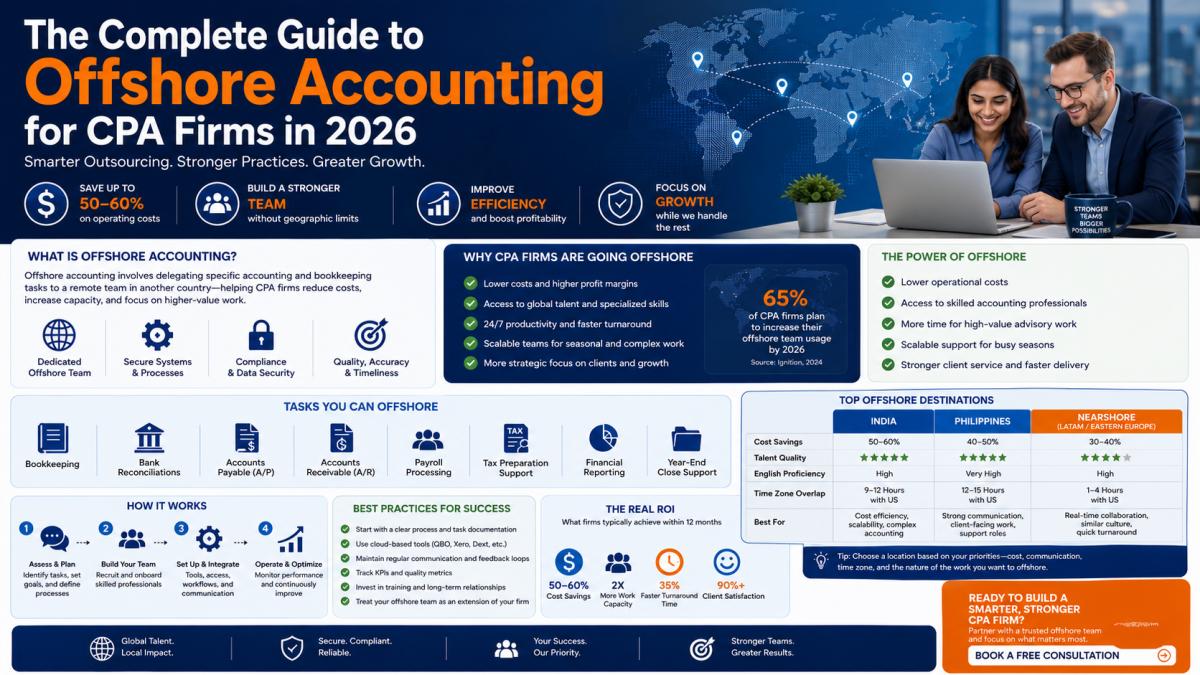
Every CPA firm owner researching offshore accounting right now is really asking one question, phrased a dozen different ways: is this actually going to work for a firm like mine, or is it going to create more problems than it solves? That's a fair question, and most content answering it either oversells the upside or buries the real concerns in vague reassurances. This guide tries to do neither. It covers why offshore accounting has become nearly unavoidable for firms trying to grow in 2026, what it actually involves, every pain point firms genuinely worry about before making the switch, and how to actually get started — including why 200+ CPA and accounting firms across the US, UK, Australia, and Ireland have chosen to build their offshore teams with Exuberant Global specifically.
Why This Conversation Is Happening Right Now
Offshore accounting isn't new. What's new is how many separate pressures are converging on CPA firms at the same time, making it far harder to solve capacity problems the way firms used to—by simply hiring more local staff.
Firm Capacity Talent Shortage 150-hr rule, fewer CPAs PE Consolidation Platforms out-invest you Seasonal Burnout Staff leave every spring OBBBA Workload New forms, more hours
Fewer new CPAs are entering the pipeline every year. Firms that lean on the same small team to survive tax season keep losing staff every spring. Private equity-backed platforms are out-investing independent firms in technology and compensation. And new tax law is adding real hours to every return without adding any new preparers to handle it. None of these forces are going away on their own. Offshore accounting has become one of the few levers a firm can pull that addresses all four at once, without needing outside capital or years to see results.
What Offshore Accounting Actually Is
At its core, offshore accounting means having trained accounting professionals — typically based in India, the Philippines, or nearshore Latin America — handle bookkeeping, tax preparation, payroll, or compliance work as an extension of your firm, rather than hiring locally for every role. The work happens under your firm's processes, software, and quality standards. Your firm's brand and client relationships stay entirely in-house.
There are a few different ways this actually gets structured, and the terminology gets used loosely enough that it's worth being precise:
| Model | What It Means |
|---|---|
| Dedicated offshore staffing | A partner sources and manages an individual who works exclusively for your firm, under your brand — the most common model for CPA firms |
| BPO / outsourced service | You outsource an entire function (e.g., bookkeeping), and a pooled vendor team delivers the output |
| Employer of Record (EOR) | A third party is the legal employer of one specific hire — a narrower, higher-cost option, rarely needed for standard accounting roles |
Every Pain Point US Firms Actually Worry About
This is the part most guides skip past. Here's an honest look at the concerns that come up in nearly every conversation about offshore accounting — and what's actually true about each one.
"Will it actually save us money, or is there a catch?"
Offshore staffing genuinely does cost 50–65% less than the fully loaded cost of an equivalent local hire once you account for salary, payroll taxes, benefits, and recruiting costs. The catch, if there is one, is timing: the first month or two go toward onboarding and training, with real savings typically showing up once the team is integrated into live client work—usually within the first tax season.
"Will the quality actually hold up to US standards?"
This depends entirely on the provider, which is exactly why vetting matters. Established offshore accounting professionals, particularly in India, are trained specifically in US GAAP, and quality control comes down to whether the provider has a real review process — a maker-checker structure where work is reviewed before it reaches you — rather than just handing you an unreviewed first draft.
"Is our clients' data actually safe?"
It should be, with the right provider. Ask directly about ISO 27001 certification (the standard for information security management), NDAs covering both your firm and your clients, and how data access is restricted. This is not a question to take on faith — ask for documentation, not just a verbal assurance.
"Do we have to tell our clients we're doing this?"
For general bookkeeping and accounting work, there's no blanket federal requirement to disclose outsourcing to clients. But for individual tax return preparation specifically, this is a real legal requirement, not just a best practice — and it's the pain point most guides skip entirely.
IRC Section 7216 requires written, signed client consent before any tax return information is disclosed to a preparer located outside the United States — even if the data stays on a US server and is only remotely accessed by offshore staff. This applies specifically to tax return preparation, not general bookkeeping. Consent forms must name the offshore recipient and are typically valid for one year unless otherwise specified. This is federal law, not optional paperwork, and it's worth building directly into your engagement letter process. Confirm your specific obligations with a qualified tax attorney or compliance advisor.
In practice, firms that build this into their standard engagement letter process — framing it as routine compliance rather than something to apologize for — report very little client pushback. Clients today are used to signing consent and privacy disclosures for all kinds of services; a clearly explained 7216 consent form tends to land as unremarkable paperwork, not a red flag.
"What if our clients find out and think we're cutting corners?"
This is more of a framing problem than a real risk. Firms that present offshore staffing as how they properly resource specialized, high-volume work — the same way a client wouldn't blink at a firm using a payroll processor or a document automation tool — tend to get a shrug, not an objection. The firms that struggle here are usually the ones who never talk about it directly and get caught explaining it defensively after the fact.
"What about time zones and communication?"
India-based teams typically work a schedule with limited daytime overlap with US business hours, but this is usually an asset, not a problem: work submitted in the evening is completed overnight and ready for review each morning, effectively extending your firm's working day. For situations genuinely needing real-time collaboration, nearshore Latin America closes that gap, at a higher cost.
"Are we going to lose control over the work?"
Control comes down to process, not geography. A dedicated offshore team working inside your firm's own software, following your standard operating procedures, with your staff doing the final review, gives you the same oversight you'd have over a new local hire—arguably more, since the work is documented and reviewed at each step rather than trusted blindly.
"Could this create legal or employment classification risk?"
It can, if the arrangement is structured carelessly. A dedicated staffing partnership, properly structured, is a well-established model used successfully across the industry. This is worth confirming directly with your provider and, for anything beyond a standard staffing arrangement, your own legal counsel.
What You Can Actually Outsource
| Function | Typical Fit |
|---|---|
| Bookkeeping & reconciliation | High — most common starting point for firms new to offshore staffing |
| Tax preparation | High — requires 7216 consent process for individual returns |
| Payroll processing | High — predictable, well-suited to offshore workflows |
| Accounts payable/receivable | High — frees local staff from routine vendor/client coordination |
| Financial reporting & month-end close | Moderate — offshore prepares; local team reviews and finalizes |
| Audit support & documentation | Moderate — strong fit for prep and documentation, not sign-off |
| Client advisory (CAS) | Low-to-moderate — usually stays local; offshore supports the data behind it |
Where to Build Your Team
India handles roughly 60–70% of US accounting outsourcing, largely due to talent depth, cost, and specialization in complex GAAP and tax work. The Philippines is a strong fit for client-facing roles like AP/AR and payroll, thanks to communication style and cultural alignment. Nearshore Latin America costs more but offers close to real-time overlap with US hours. Most firms starting out do best concentrating their first hires in one region before considering a multi-geography approach later.
Getting Started: A Realistic Roadmap
Identify Your biggest capacity gap → Vet Certifications, QC, retention → Pilot 1–2 roles, real workflows → Integrate & Scale Fold into standard operating procedure
Start with one clear pain point — usually bookkeeping capacity or tax season overflow — rather than trying to offshore everything at once. Vet the provider on certifications, quality control process, and staff retention rate before signing anything. Pilot with one or two roles inside your real workflows, not a sandboxed test. Once that's working, integrate the team into your standard operating procedure and expand from there.
How to Vet a Provider
- Ask for proof of ISO 27001 (data security) and ISO 9001 (quality management) certification, not just a claim
- Ask what their maker-checker review process actually looks like before work reaches you
- Ask about their staff retention rate — high turnover on their side becomes disruption on yours
- Confirm the engagement is white-labeled and NDA-protected, covering both your firm and your clients
- Ask how fast a trained professional can actually start, and what onboarding looks like in practice
- Request references from current CPA firm clients, not just general testimonials
Run this checklist against Exuberant Global, and here's what you'll find: ISO 9001, ISO 10002, and ISO 27001 certified; GDPR compliant; 100% white-labeled and NDA-protected; a 98.9% client retention rate; and 200+ CPA and accounting firms already trusting us with exactly this work. It's the reason firms keep choosing us over providers who can only offer verbal assurances.
Why 200+ CPA Firms Choose Exuberant Global
We built Exuberant Global specifically around every pain point covered in this guide, because we've spent 12 years watching CPA firms run into them firsthand. Today, we work with 200+ accounting and CPA firms across the US, UK, Australia, and Ireland—and we've become the go-to offshore partner for firms that want the capacity benefits of offshore staffing without gambling on an unproven provider.
🏆
98.9% client retention rate
The clearest signal that firms who start with us stay with us — because the work holds up season after season.
🔒
ISO 9001, ISO 10002, and & ISO 27001 certified, GDPR compliant
The exact certifications this guide told you to demand from any provider — documented, not just claimed.
🎭
100% white-labeled, NDA-protected
Your clients see your firm and only your firm. Our team works as an invisible extension of yours, every time.
🌐
12 years, 200+ firms, 4 countries
Not a startup experimenting with your firm's workflow — a proven partner with a long track record across the US, UK, Australia, and Ireland.
This is exactly why we'd encourage you not to take our word for it and instead run us through the vetting checklist above yourself. Every question this guide told you to ask a provider is a question we're ready to answer with documentation, not just reassurance. If your firm is dealing with any of the pain points covered in this guide — capacity gaps, burnout, rising local hiring costs, or the pressure of competing against PE-backed platforms — that's precisely the problem we built Exuberant Global to solve.
Frequently Asked Questions
How quickly can a firm actually get an offshore team running?
Most firms can have a trained professional onboarded and contributing within one to two weeks of choosing a provider, though building the full workflow integration typically takes a full season to mature.
Do we need a 7216 consent form for bookkeeping work too?
Generally no — Section 7216 specifically covers tax return information. General bookkeeping and accounting work outside of tax preparation isn't governed by the same consent requirement, though it's worth confirming with a compliance advisor if your engagement blends both.
What happens if the offshore relationship doesn't work out?
A properly structured staffing partnership should allow you to scale down or exit without the complications of a local termination. Confirm exit terms and notice periods before signing any agreement.
Is this only for large firms?
No. Solo practitioners and two-partner firms use the same model at a smaller scale, often starting with a single offshore bookkeeper before expanding.
Final Thoughts
Offshore accounting isn't a shortcut, and it isn't risk-free, but it's also not the leap of faith it might feel like from the outside. The firms getting real value out of it are the ones who went in with clear eyes about the pain points—cost, timing, quality control, data security, 7216 compliance, and client communication—and chose a provider that could actually answer those questions with documentation, not just reassurance. That's the standard we hold ourselves to at Exuberant Global, and it's why 200+ firms have trusted us to be that provider.
Ready to see what this looks like for your firm? Get in touch with us for a free consultation, or go straight to Build Your Team to start putting together your dedicated offshore accounting team today.
Ready to Scale Your Business?
Connect with our experts to learn how our outsourcing solutions can drive growth.
BOOK A DISCOVERY CALL