 : +1 308-7304-232
 : +44 (744)-139-7094
 : +61 4 8080-3582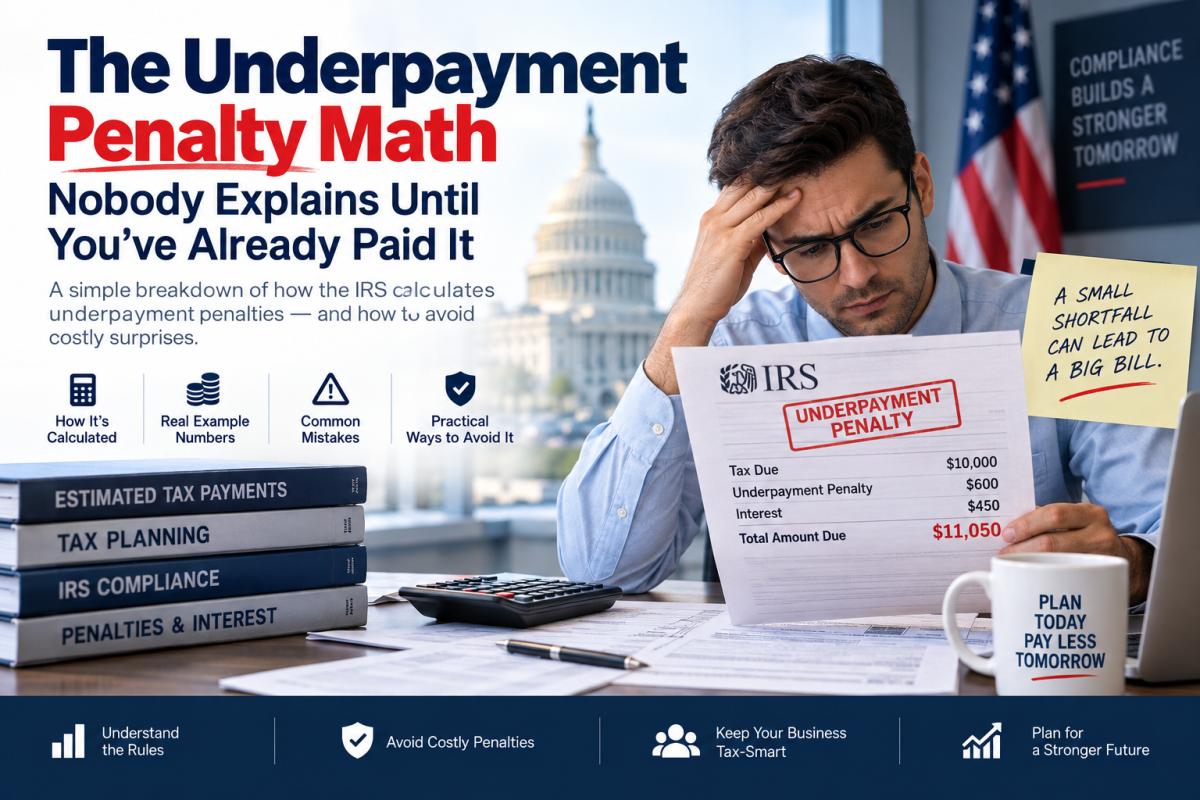
Here's a specific, common scenario: someone leaves a W-2 job partway through the year to go out on their own—freelance, consulting, or a new business. It doesn't matter which. All year, taxes just happened automatically, withheld from every paycheck without anyone thinking about it. Now nothing is being withheld from anything, and the first time this genuinely registers as a problem is the following spring, looking at a tax bill that's not just larger than expected but has a penalty tacked onto it for money that was, technically, already owed months earlier.
That penalty isn't a flat fine, and it isn't really separate from ordinary interest—it's daily-compounding interest charged on money the IRS considers it should have already received, calculated quarter by quarter rather than as one annual number. Understanding how that math actually works is the difference between a business that plans around it and one that gets surprised by it every single year.
Who This Actually Applies To
If taxes get withheld automatically from every paycheck, this mostly isn't a concern—withholding is treated as if it were paid evenly throughout the year regardless of when it actually happened. The people and businesses who need to pay attention are the ones receiving income with nothing withheld from it: self-employed individuals, freelancers, most small business owners, anyone with significant investment or rental income, and S-corp owners taking distributions on top of their W-2 salary. If you expect to owe $1,000 or more in tax for the year after subtracting withholding and credits, the IRS generally expects quarterly payments along the way, not one lump sum at filing time.
The 2026 Quarterly Deadlines
The IRS's quarterly periods don't actually split the year into even thirds or quarters, which trips people up more than it should—the "quarters" are uneven in length by design.
| Period | Covers | Payment Due |
|---|---|---|
| Q1 | January 1 – March 31 | April 15, 2026 |
| Q2 | April 1 – May 31 | June 15, 2026 |
| Q3 | June 1 – August 31 | September 15, 2026 |
| Q4 | September 1 – December 31 | January 15, 2027 |
Notice Q2 covers only two months, while Q1, Q3, and Q4 each cover roughly three—a quirk of how the IRS structured the calendar decades ago that still catches people off guard, particularly anyone assuming each payment covers an equal three-month stretch.
The Safe Harbor Rules: How to Never Owe This Penalty at All
This is the part worth understanding properly, because the safe harbor rules are genuinely a complete defense—meet either one, and the underpayment penalty simply doesn't apply, regardless of how much you actually end up owing at filing time.
| Safe Harbor | What It Requires |
|---|---|
| Current-year basis | Pay at least 90% of the current year's total tax liability through withholding and estimated payments. |
| Prior-year basis (AGI $150,000 or below) | Pay at least 100% of last year's total tax liability. |
| Prior-year basis (AGI above $150,000) | Pay at least 110% of last year's total tax liability. |
The prior-year basis is usually the more practical one to plan around, because it's a known, fixed number from a return you've already filed—you're not trying to forecast this year's income accurately mid-year, just matching a percentage of a figure that's already settled. There's also a small built-in exception worth knowing: if your total underpayment for the year comes out under $1,000 after withholding and payments, no penalty applies regardless of which safe harbor you did or didn't hit.
Why a Strong Fourth Quarter Doesn't Fix a Weak First Quarter
This is the detail that catches even people who are otherwise being careful. The underpayment penalty is calculated separately for each quarterly period, not as a single annual reconciliation. If Q1 was underpaid because income came in higher than expected early in the year, and Q2 through Q4 were paid correctly, that Q1 shortfall still accrued its own penalty for the specific stretch of time it went unpaid—a strong finish to the year doesn't retroactively erase an earlier gap.
Here's a concrete version of how this plays out: imagine a business paid $8,000 in estimated payments across the year but actually owed $12,000. That $4,000 underpayment doesn't just sit quietly until filing season—it accrues daily-compounding interest at the quarterly underpayment rate from whichever due date it was actually short, running until it's paid or until the following April 15, whichever comes first. A shortfall from an early quarter has simply been accruing longer than the exact same dollar shortfall from a later one.
What the Penalty Rate Actually Is
The underpayment rate isn't a fixed number set once a year—the IRS resets it quarterly, tied to the federal short-term rate plus three percentage points, and it moved more than once within 2026 alone.
| 2026 Quarter | Underpayment Rate |
|---|---|
| Q1 (Jan–Mar) | 7% |
| Q2 (Apr–Jun) | 6% |
| Q3 (Jul–Sep) | 7% |
| Q4 (Oct–Dec) | 7% |
And because the interest compounds daily rather than simply, the effective annual cost runs slightly higher than the headline number suggests—a nominal 7% rate works out to roughly 7.25% actually applied over a full year, since each day's interest gets added to the balance before the next day's interest is calculated on top of it. On a small shortfall, the difference between simple and compounded is trivial. On a five-figure underpayment carried for months, it adds up to real money beyond the headline rate.
What Actually Happens If You Underpay
In most cases, nothing needs to be filed proactively. The IRS calculates the penalty itself and simply includes it on a bill after your return is processed. Form 2210 exists specifically for the situations where you want to reduce or contest that calculation—for example, if your income was genuinely uneven throughout the year and the standard even-quarters assumption overstates what you actually owed in an earlier period. Filing it yourself is optional in most cases and only worth the extra paperwork if it would meaningfully lower what the IRS would otherwise bill automatically.
Where the Real Risk Actually Sits
The businesses and individuals who get caught by this aren't usually careless—they're usually working from numbers that were accurate months ago but aren't accurate anymore. A business that had a strong Q3 nobody updated the estimate for. A self-employed person whose income genuinely jumped mid-year without anyone recalculating the safe harbor target against it. A newly self-employed person who simply didn't know quarterly payments were expected at all, because nothing in their prior W-2 life ever required thinking about it.
All of that traces back to the same underlying requirement: knowing your actual, current-year numbers well enough to calculate a safe harbor target accurately, not working from a stale guess. That's precisely where current, accurate bookkeeping stops being a nice-to-have and becomes the thing that actually prevents a penalty—you can't hit 90% of a number you don't actually know yet. The same logic runs through cash flow forecasting more broadly: a business with a clear, current picture of its own numbers is planning its quarterly payments deliberately, while a business working from three-month-old figures is essentially guessing and hoping the gap isn't large.
Frequently Asked Questions
Do I need to pay the exact same amount each quarter? Not necessarily—the standard calculation assumes even quarters, but Form 2210's Annualized Income Installment Method exists specifically for income that arrives unevenly throughout the year, letting each quarter's required payment reflect income actually earned by that point rather than a flat one-fourth assumption.
What if I genuinely don't know what I'll owe this year yet? This is exactly why the prior-year safe harbor exists—basing payments on 100% (or 110%) of last year's already-known tax liability sidesteps the need to forecast a currently uncertain number accurately.
Does an S-corp salary count as withholding for this purpose? Yes—W-2 wages from an S-corp, including a shareholder-employee's own salary, are withheld just like any other paycheck and count toward the safe harbor the same way regular employment withholding would. This is one of the practical mechanics behind the reasonable-salary math we cover in our S-corp election guide.
What happens if I miss just one quarter but I'm on track for the others? That missed quarter still accrues its own penalty for the period it went unpaid, calculated independently—catching up in a later quarter stops the shortfall from growing further but doesn't erase the interest that already accrued on the missed one.
Is there any way to fully avoid this if my income is genuinely unpredictable? The prior-year safe harbor is the most reliable option precisely because it doesn't depend on predicting anything—it's based on a number that's already fixed and known, which makes it the most defensible target for anyone with volatile or hard-to-forecast income.
The Bottom Line
The underpayment penalty isn't designed to be punitive in some abstract sense—it's simply daily interest on money the IRS expected to have already, charged from the point it was actually due rather than whenever it eventually got paid. The safe harbor rules exist specifically to make this avoidable entirely, and the businesses that never think about this penalty again aren't the ones with the most accountants—they're the ones whose quarterly numbers are current enough to hit 100% or 110% of last year's tax without having to guess.
If keeping those numbers current and accurate is the part that keeps slipping, outsourced tax preparation support can keep the underlying bookkeeping current enough that quarterly estimates are a five-minute calculation instead of a scramble every few months.
Ready to Scale Your Business?
Connect with our experts to learn how our outsourcing solutions can drive growth.
BOOK A DISCOVERY CALL