 : +1 308-7304-232
 : +44 (744)-139-7094
 : +61 4 8080-3582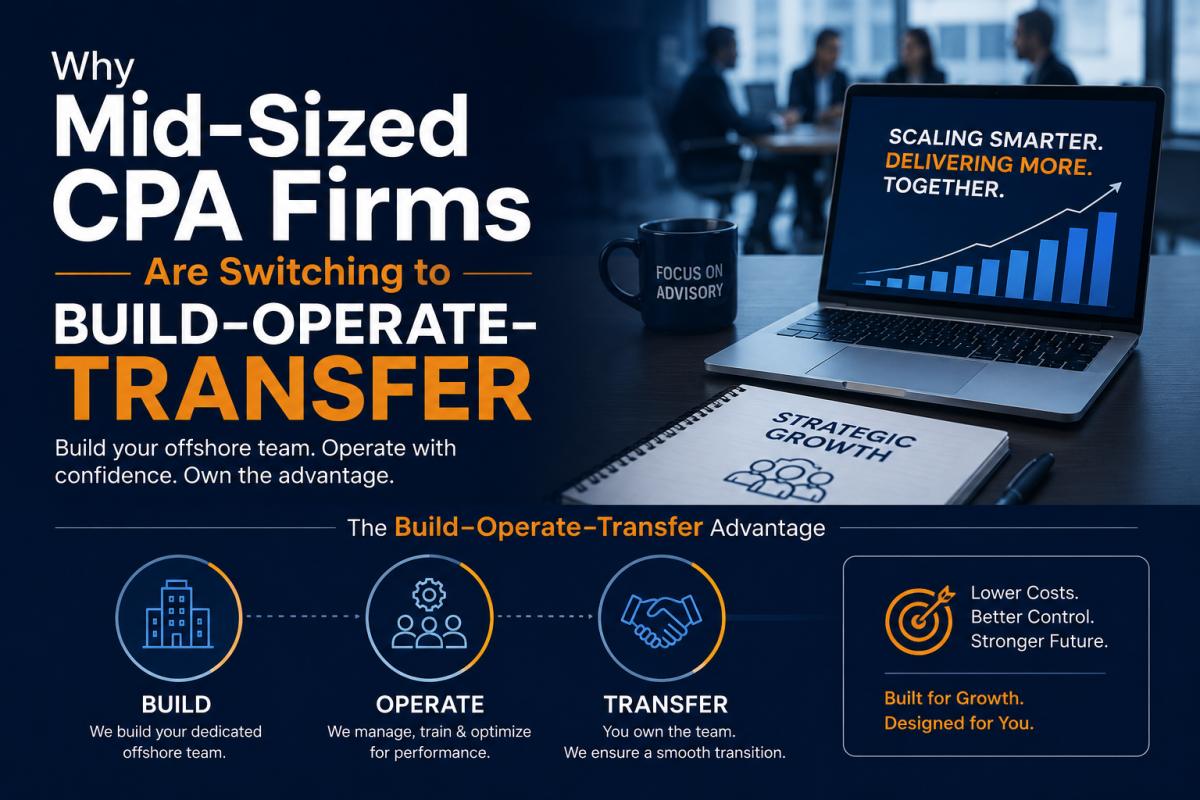
The Capacity Dilemma Facing Mid-Sized CPA Firms
Mid-sized CPA practices—those with roughly 20 to 150 team members—are caught in a relentless squeeze. They tackle complex corporate clients, multi-state tax returns, and full-scope audits just like national heavyweights. The catch? They don't have tens of millions lying around to build out proprietary offshore delivery centers in places like Manila or Bangalore from scratch.
For years, managing partners relied on traditional staffing agencies or transactional BPO vendors as a temporary pressure valve. Right before tax season, firms would queue up hundreds of returns or audit workpapers into a vendor's black-box portal, praying for clean returns back in 48 hours. That approach has run out of runway. High turnover, erratic quality, constant rework, and creeping data privacy rules have turned classic vendor outsourcing from a quick fix into an administrative headache.
To protect realization rates and stop partner burnout, forward-thinking leaders are pivoting to a smarter playbook: the Build-Operate-Transfer (BOT) model. Instead of renting generic bench strength from a third party, mid-sized firms use BOT to construct, operate, and eventually own a dedicated offshore team tuned directly to their internal workflows.
Why Traditional Accounting Outsourcing Has Hit a Ceiling
Traditional outsourcing was built for simple task completion, not long-term process ownership. In a standard vendor arrangement, work is thrown into a shared pool. You might have five different junior preparers touching a single client account over the course of a month. That creates friction points that active practice leaders know all too well:
- The Rework Spiral: When offshore staff don't understand your firm's specific review habits or software preferences (whether CCH Axcess, UltraTax, or Drake), domestic managers spend twice as long reviewing workpapers. A file meant to save six staff hours ends up burning three hours of partner time just on corrections and reviews.
- Turnover and Context Loss: Annual turnover in broad-market BPO vendor pools regularly tops 30%. That means starting every busy season from square one—retraining new agency staff on your portals, document naming rules, and workflow engines like Karbon or Canopy.
- Data Security and IRS Compliance Risk: Routing client records through generic third-party servers creates real regulatory hazards. Under tax return preparer disclosure rules, accounting firms must maintain tight, verifiable control over who touches client data. Standard transactional vendors rarely provide the audit trails or direct security access required for enterprise-grade assurance.
- Zero Asset Creation: Pay monthly invoices to a transactional vendor for five years, and what do you own at the end? Nothing. The expertise, process refinements, and institutional memory remain locked inside the vendor's organization.
If you are building firm equity ahead of a partner transition or private equity investment, vendor spend is pure overhead—zero balance sheet value built whatsoever.
Demystifying the Build-Operate-Transfer (BOT) Model
The Build-Operate-Transfer model bridges the gap between third-party vendor reliance and the risky proposition of building a foreign subsidiary alone. It gives you an in-house offshore team without forcing your leadership team to wade through foreign labor laws, local tax compliance, or international payroll setup on day one.
Key Takeaway: The BOT model allows a mid-sized firm to build a custom, dedicated offshore operational team managed by an expert partner, with the contractual right to absorb the entire operational infrastructure into its own corporate structure once scaled.
The model operates across three distinct phases:
1. Build
During the build phase, your offshore strategic partner collaborates directly with your leadership to shape a custom practice structure. Candidates aren't pulled from a generic bench; they are recruited specifically for your tech stack, service lines, and firm culture. Whether you are expanding your outsourced tax preparation group or strengthening your core audit team, your own managers interview and choose every hire. The build phase also establishes physical or enterprise-grade virtual workspaces, dedicated hardware, security protocols, and custom training.
2. Operate
In the operational phase, the partner handles local logistics—foreign payroll compliance, labor law, healthcare benefits, facilities, and local IT maintenance. But day-to-day work delivery, priorities, and standards are driven directly by your firm. These team members attend your morning huddles, use your firm email domain, log into your cloud environment, and operate as a seamless extension of your domestic team. Exuberant Global's model for building a dedicated offshore team ensures operational control stays firmly with your practice leads, eliminating middle-management proxies.
3. Transfer
This is where BOT sets itself apart. After a set period (typically 24 to 36 months) or upon reaching a target headcount, your firm exercises its option to transfer the entire offshore setup under its own corporate entity. Staff contracts, infrastructure, management structures, and processes move over cleanly. You end up owning a mature, fully compliant offshore delivery center without having endured the early setup headaches and legal risks.
Comparing Delivery Models for Mid-Sized Firms
To see why firm leaders are moving toward BOT, it helps to compare the three core options side-by-side across real operational metrics.
| Evaluation Criteria | Traditional BPO Vendor | Direct Foreign Setup (DIY) | Build-Operate-Transfer |
|---|---|---|---|
| Capital Investment | Low initial setup cost | Very High ($250k-$500k+) | Low to Moderate |
| Hiring & Control | None (Vendor assigns pool) | Complete Control | Direct Candidate Selection |
| Process Integration | Poor (Vendor processes) | Deep Firm Alignment | Deep Firm Alignment |
| Regulatory Burden | Vendor-managed (High risk) | Firm assumes all risk | Partner-managed compliance |
| Asset Ownership | Zero balance sheet asset | Owned from Day 1 | Option to Transfer Asset |
5 Strategic Drivers Accelerating the Shift to BOT
1. Building Firm Equity and Enterprise Valuation
Private equity buyers and incoming partners focus heavily on EBITDA quality and scalability. A firm relying on transactional vendors for 30% of its capacity carries massive execution risk—if vendor quality drops or prices rise, your profit margins collapse overnight.
A BOT framework builds a real operational engine instead. Once transferred, that offshore practice sits directly on your balance sheet as a wholly-owned delivery center. It permanently expands operating margins, turning labor spend into a defensible enterprise asset that commands higher valuation multiples.
2. Strict Adherence to Professional Standards and Data Governance
Data privacy regulations governing financial data get tighter every year. Managing Section 7216 disclosure compliance during tax season requires rigid governance over offshore access. The Internal Revenue Service sets clear standards around data handling, client authorization, and system security.
Under a BOT setup, your exact cybersecurity rules apply. Staff access your systems using encrypted virtual desktops, hardware MFA, and strict data loss prevention monitoring. Instead of uploading client files into an external vendor database, your offshore team works directly inside your secure tenant environment. This direct integration keeps your firm aligned with AICPA professional standards regarding independence, technical quality control, and client privacy.
3. Direct Process Standardisation and Cultural Alignment
Standardizing processes across service lines is tough enough domestically. Throw in a transactional vendor, and inconsistency accelerates. One partner might use the vendor for simple 1040s, while another avoids them entirely because of bad past returns.
With BOT, because you hire dedicated offshore accountants directly, these professionals train on your exact SOPs and workflow tools. They learn your firm's specific paperless habits, software preferences, and diagnostic steps. Over time, they become true process experts who actively suggest workflow improvements for the domestic team.
4. Protection Against Turnover and Knowledge Loss
When a key preparer at a generic vendor leaves, their domain knowledge vanishes with them. The vendor simply plugs another body into the slot, forcing your managers back into training mode. BOT solves this through integrated team culture and localized management support.
Offshore staff inside a BOT framework receive strong local compensation, full health benefits, clear career progression, and ongoing training. Because they are integrated directly into your brand rather than treated as disposable agency reps, retention levels regularly double those seen in broad-market BPO centers.
5. Expansion into Complex Service Lines Beyond Standard Bookkeeping
Basic BPO arrangements work reasonably well for repetitive tasks like bank reconciliations. But mid-sized firms need offshore depth across complex, high-margin service lines. They need assistance with corporate tax setups, complex trusts, multi-entity consolidations, and detailed audit testing.
Selecting specialist candidates directly allows you to build targeted practice pods. For instance, mid-sized firms can set up dedicated pods for outsourced audit support to execute internal control testing and substantive analytics, or build specialized teams driving full-scope outsourced accounting services inside client advisory practices (CAS).
The Math Behind the Model: Unit Economics for a 40-Person CPA Firm
To see the financial picture clearly, let's look at the unit economics for a typical 40-person US CPA firm adding 8 senior-level accountants across tax, audit, and CAS.
Domestic Hiring Realities:
- Average US Senior Accountant Salary: $95,000
- Payroll Taxes, Healthcare, & Benefits (22%): $20,900
- Software Licenses, Hardware, & Workstation Overhead: $8,500
- Recruitment Fees (20% of base): $19,000 (one-time)
- Total Fully-Loaded Cost Per Senior Accountant: $124,400/year
- Total Investment for 8 Senior Accountants: $995,200/year
BOT Model Economics (Offshore Dedicated):
- Fully-Loaded Salary & Benefits (Offshore Senior): $26,000
- Partner Operational & Management Platform Fee: $7,000
- Enterprise IT Infrastructure & Hardware: $2,500
- Total Fully-Loaded Cost Per Senior Accountant: $35,500/year
- Total Investment for 8 Senior Accountants: $284,000/year
Domestic Cost (8 Senior FTEs)
$995,200 / year
BOT Model Cost (8 Senior FTEs)
$284,000 / year
That is over $710,000 in direct annual operational savings. Even better, unlike vendor arrangements where constant rework tanks billable efficiency, a dedicated BOT team operates at domestic-equivalent output once onboarded, driving partner realization rates back above 85%.
Operational Roadmap: Transitioning Your Firm to a BOT Framework
Transitioning from pure domestic hiring or a fragmented vendor setup to a Build-Operate-Transfer strategy requires clear, disciplined execution.
Phase 1: Capacity & Service-Line Diagnostic (Weeks 1–4)
Don't try to move everything offshore at once. Map out where domestic staff spend excessive time on repetitive, lower-margin work. Tax preparation, audit workpaper assembly, and CAS month-end closes are natural starting points. Set clear operational guidelines, software prerequisites, and target billable hours for the incoming offshore team.
Phase 2: Tailored Talent Selection & Enterprise Security Setup (Weeks 5–10)
Your offshore partner starts recruiting based on your explicit role requirements. Practice leads conduct final video interviews, choosing candidates based on technical skill and firm fit. Simultaneously, secure virtual environments are configured so that data security, device encryption, and network rules mirror domestic compliance policies.
Phase 3: Work Embeddedness & Operational Management (Months 3–24)
New team members go through a joint onboarding process. They receive firm email addresses, join your Teams or Slack channels, and attend daily check-ins. Work flows directly through your existing practice management tools. The local partner handles HR, local payroll compliance, and facilities, letting your managers focus purely on production, review, and client output.
Phase 4: Execution of Transfer (Months 24–36)
Once your offshore footprint reaches scale—typically after two to three years of stable operation—your firm exercises its option to incorporate the offshore entity directly. Employment contracts, office leases, IT assets, and operations transfer smoothly into your firm's local subsidiary. You end up owning a fully functional foreign operations hub without ever having taken on early-stage setup risks.
Refactoring the Growth Trajectory of Your Practice
The shortage of qualified accounting talent isn't a temporary crunch—it's a permanent structural shift. Firms relying solely on traditional domestic hiring will watch realization margins shrink while partners burn out. On the flip side, relying on transactional vendor portals creates quality risks and data headaches that hamper long-term growth.
The Build-Operate-Transfer model gives mid-sized CPA firms a practical way forward. It offers the talent access, cost efficiency, and quality control of an in-house offshore delivery center, backed by the operational security of an experienced international partner. By converting operational spend into a strategic balance-sheet asset, mid-sized practices can build reliable capacity, protect partner realization, and significantly increase firm valuation.
Ready to build a dedicated, high-performing offshore team for your CPA practice? Reach out to our team today to schedule a free strategy consultation and explore how a custom Build-Operate-Transfer roadmap can transform your firm's growth.
Ready to Scale Your Business?
Connect with our experts to learn how our outsourcing solutions can drive growth.
BOOK A DISCOVERY CALL