 : +1 308-7304-232
 : +44 (744)-139-7094
 : +61 4 8080-3582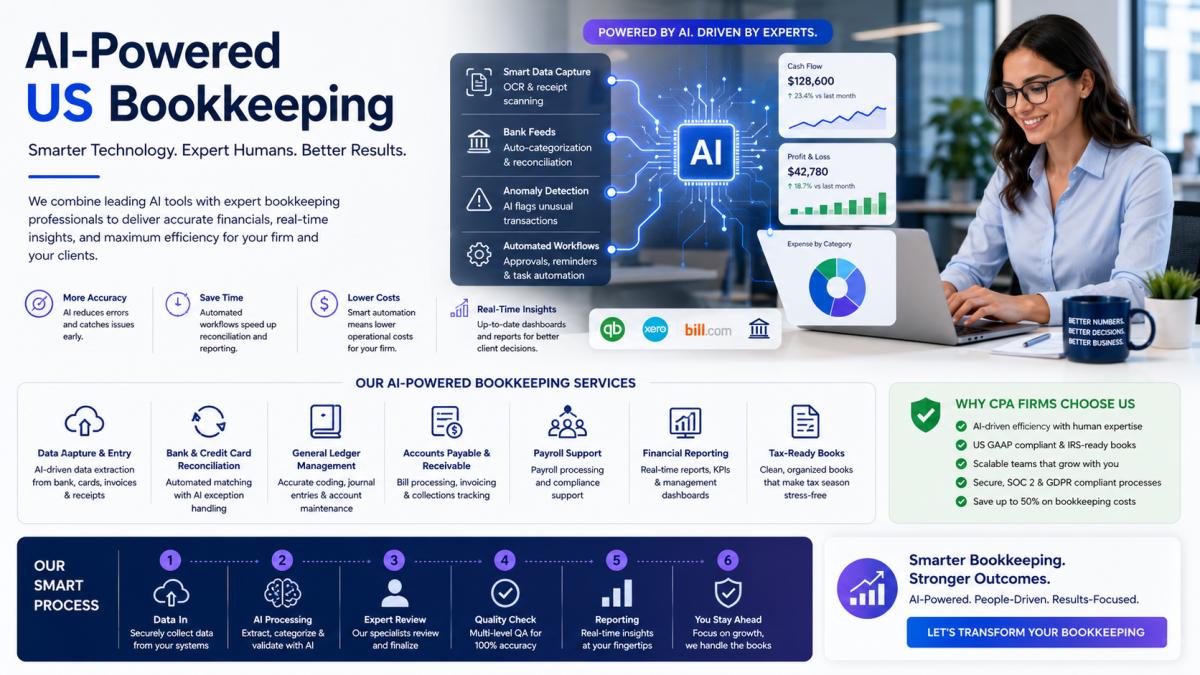
If you run a US-based accounting firm or finance department, you already know the feeling: month-end arrives, and suddenly your team is buried in bank statements, credit card feeds, and a stack of invoices that all need to be coded correctly before the books can close. Manual bookkeeping for US-based organizations is a perpetual race against time. Between processing hundreds of bank transactions and coding related invoices in QuickBooks or Xero, accounting staff spend up to 70% of their working hours on routine data entry tasks.
It's not that your team isn't capable — it's that traditional bookkeeping simply wasn't built for the volume of transactions modern businesses generate. That's exactly the gap that AI bookkeeping automation was designed to close.
Thanks to Machine Learning developments and optical character recognition, AI-enabled US bookkeeping can now reconcile transactions in real-time. However, double-checking AI-assisted reconciliation poses certain risks due to potential coding errors or hallucinations. The most reliable way to leverage the power of autonomous processes is to combine them with human expertise.
Below are the key benefits of the hybrid approach to US bookkeeping, which utilizes cutting-edge technology and native American accounting know-how.
Why Hybrid Bookkeeping Is Gaining Ground in the US
Firms aren't adopting hybrid bookkeeping services because AI is trendy — they're adopting it because the alternative is burnout. CPA firms and in-house finance teams are already stretched thin by staffing shortages, seasonal workload spikes, and rising client expectations for real-time financial visibility. Pure automation promises speed but can't be trusted with judgment calls. Pure manual processing is accurate but slow and expensive. The hybrid bookkeeping model exists precisely because businesses need both: the speed of automated bank reconciliation and the judgment of a trained bookkeeper who understands US GAAP and IRS requirements.
The AI + Human Hybrid Model: How It Works
When it comes to bookkeeping, Exuberant Global’s accounting specialists apply a hybrid method that integrates leading-edge financial technologies and high-caliber US-based professionals. The following steps help automate bank reconciliation in real-time while ensuring compliance with GAAP standards and providing auditors with all the necessary documentation:
Bank and Credit Card Feeds: Automated Data Ingestion and Extraction
Banking data, including deposits, payments, and expenses, is ingested into the accounting ERP through application programming interfaces or by scanning physical checks and invoices. Using advanced OCR tools, the system extracts relevant data fields such as the vendor’s name, invoice or payment number, transaction date, line item costs, and taxes.
Machine Learning Matching
The AI component of the system matches this information to the general ledger accounts and classifies it accordingly. Invoices and payments with a high degree of certainty (95% confidence interval) can be automatically posted to the corresponding accounts.
Exception Routing
Transactions that have a low degree of confidence and potential to cause disputes are routed to the next step in the reconciliation process.
Human-in-the-Loop Quality Review
A native English bookkeeper reviews the information to ensure that the system has selected the correct general ledger accounts, flagged 1099 vendors if applicable, and followed the required tax deduction rules. This step helps meet the exacting requirements of US tax laws and provides complete transparency since all documents are available in digital form.
Continuous Learning and Optimization
Every time a human specialist reviews the information, the machine learning engine learns how to improve its performance. As a result, the number of exceptions declines by up to 75% or more over a 90-day period.
What makes this workflow effective isn't the technology alone — it's the feedback loop between the machine learning engine and the human bookkeeper. Every correction a reviewer makes trains the system to recognize similar transactions faster next time, so the exception queue keeps shrinking the longer the relationship runs.
Why AI is Not Enough for US Bookkeeping: The Need for Human Oversight
While autonomous technologies can accelerate the reconciliation process, preparing financial statements for submission always requires human expertise. AI makes mistakes, especially when it comes to ambiguous vendor categorization and tax rules. Below is a shortlist of situations when the skills of an accountant are needed to review AI-automated bookkeeping data:
Ambiguous vendor categorization
An expense report can list multiple vendors, including Square, PayPal, or another third-party app. An accountant can determine whether these are software-as-a-service expenses or payments to independent contractors.
1099 tax rules
An AI tool may not know whether to withhold taxes for an LLC, C-Corp, or a sole proprietor according to the IRS guidelines.
Accrual accounting and period cuts
The software may have trouble with cut-off rules and other accrual techniques needed to create accurate financial statements.
These are the moments where experience matters more than processing power. A seasoned bookkeeper doesn't just apply a rule — they understand the story behind a transaction, which is something no algorithm can fully replicate yet.
Key Benefits of the Hybrid Bookkeeping Approach
| Traditional Manual Process | AI + Human-in-the-Loop Process | |
|---|---|---|
| Time to reconcile | 3 to 7 days per month-end | Real-time daily reconciliation |
| Transaction accuracy | 92% – 95% | 99.8% |
| Operational costs | Higher | Lower by up to 50% |
| Audit trails | Document hunting required | Full digital trail with instant access to supporting documents |
Taken together, these numbers tell a simple story: firms that adopt a hybrid bookkeeping model aren't just saving time, they're reducing risk. Faster reconciliation means fewer surprises at month-end close, higher accuracy means fewer restatements, and a complete digital audit trail means your team isn't scrambling to find supporting documents when auditors come calling.
Choosing the Right Outsourced Bookkeeping Partner
Not every provider that offers "AI-powered bookkeeping" actually backs it with trained human reviewers. Before you commit to a partner, it's worth asking a few pointed questions: Who reviews the exceptions the AI can't confidently classify? Are the reviewers familiar with US GAAP, 1099 rules, and IRS reporting requirements, or are they simply approving whatever the software suggests? And how quickly does the system actually learn from corrections, versus repeating the same mistakes month after month?
This is where a firm like Exuberant Global's outsourced bookkeeping services stands apart — the AI-driven reconciliation is paired with experienced bookkeepers who understand US compliance requirements, not just software rules. That combination is what actually moves the needle on accuracy, not the AI in isolation.
Frequently Asked Questions About Hybrid Bookkeeping
Is AI-powered bookkeeping safe for US tax compliance?
AI can handle repetitive matching and coding reliably, but tax compliance decisions — like 1099 classification or accrual cut-offs — still require a human bookkeeper familiar with IRS rules to review and sign off before anything is finalized.
How much time can a hybrid bookkeeping model actually save?
Most organizations move from a multi-day month-end reconciliation process to real-time daily reconciliation, freeing up accounting staff who previously spent up to 70% of their time on manual data entry.
Does switching to AI-assisted bookkeeping mean losing the human touch?
No. The hybrid model is built specifically so a human reviewer stays in the loop for every exception, ambiguous vendor, or judgment call — the AI simply removes the repetitive work so bookkeepers can focus on the transactions that actually need their expertise.
By combining AI-powered banking feed reconciliation with native English accountants’ expertise, Exuberant Global helps organizations achieve the best of two worlds. We automate repetitive tasks while ensuring full compliance with US tax regulations and providing auditors with all the documentation they need.
Are you looking to optimize the month-end close process or outsource your financial operations to a team that understands US accounting standards? Explore Exuberant Global’s Outsourced Bookkeeping Services and request a free discovery call to discuss your requirements. Our experts will walk you through the details of the hybrid bookkeeping approach and help you select the right level of automation for your business.
Ready to Scale Your Business?
Connect with our experts to learn how our outsourcing solutions can drive growth.
BOOK A DISCOVERY CALL