 : +1 308-7304-232
 : +44 (744)-139-7094
 : +61 4 8080-3582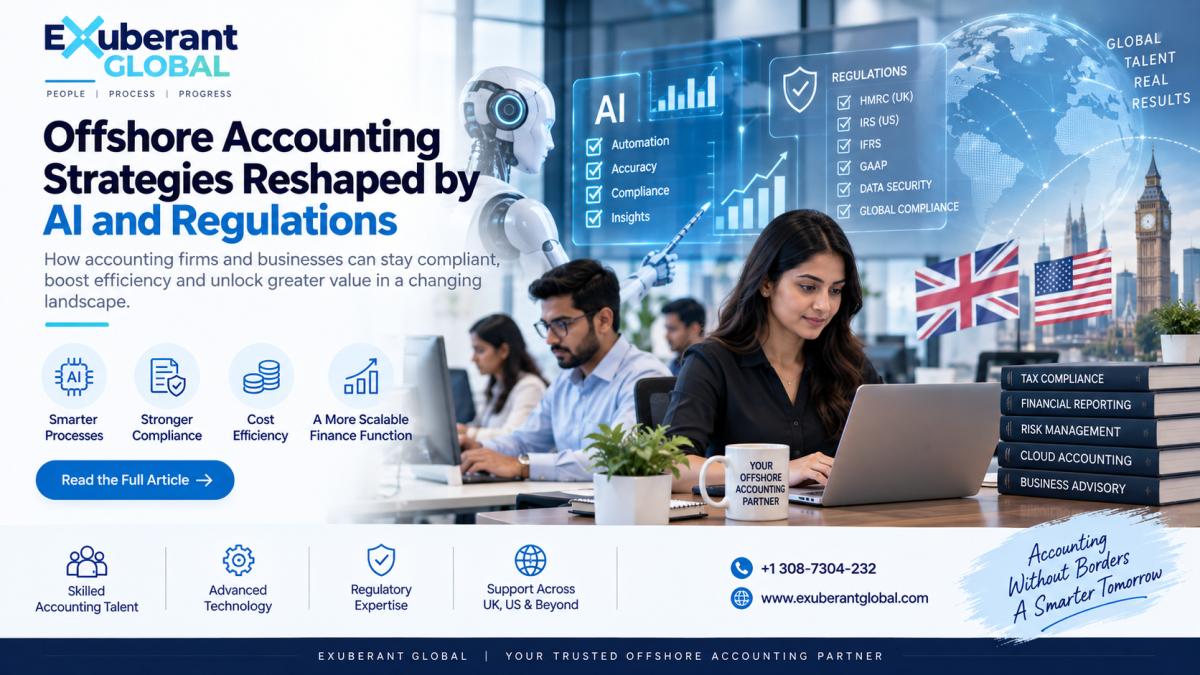
The Paradigm Shift in Offshore Accounting
Forget everything you thought you knew about traditional offshoring. For years, the math for CPA firms across the US, UK, Canada, Australia, New Zealand, and Ireland was pretty straightforward: track down a cheap region, dump the grunt work—think basic bookkeeping, AP processing, and tax return assembly—and pocket the wage gap. You could easily shave 50% to 70% off your onshore labor costs.
Times have changed. The global economy and tech stack shifted underneath us, and now two massive forces are slamming into each other. On one side, data privacy laws and compliance rules are tightening up globally. On the other, AI and machine learning are tearing through everyday accounting workflows.
If your firm still looks at offshore staff as just human data-entry bots, you're missing the boat entirely. The firms actually growing right now are the ones upgrading their offshore setups to run alongside advanced automation while keeping a tight grip on compliance. Let's dig into how AI and regulation are completely rewriting the playbook.
The Regulatory Squeeze: Compliance Beyond Borders
Here's the kicker: when you outsource, your liability stays right where you are. You're still on the hook for client data security, accurate filings, and playing by the rules set by the AICPA, ICAEW, or CPA Australia. And regulators are watching closely. Between GDPR in Europe, CCPA in California, and similar privacy acts across British Columbia, Ontario, and New South Wales, handling PII has become a legal minefield.
Tax authorities are cracking down, too. When firms lean on outsourced tax preparation, they have to ensure every remote worker passes strict background checks, logs in through secure virtual desktops (VDIs), and signs airtight non-disclosures. Regulators don't care about handshake promises anymore. They want proof of data governance, multi-factor authentication everywhere, and ironclad audit trails.
Navigating Cross-Border Standards
Every region has its own rulebook. US firms answer to the IRS, while UK practices deal with HMRC and strict anti-money laundering (AML) laws. Because of this, picking up random freelancers on digital marketplaces just doesn't cut it anymore. Smart CPA firms are moving toward dedicated, structured offshore teams working out of ISO-certified setups. Whether you're scaling up outsourced bookkeeping services or tackling messy year-end accounting/closing services, compliance is the absolute baseline.
The AI Revolution: What Happens to Offshore Labor?
Every time tech advances, the doomsayers claim human jobs are history. We heard it when OCR arrived, and we're hearing it now with generative AI and intelligent document processing. But inside forward-thinking CPA firms, the reality is a lot more practical.
AI is incredible at reading messy PDF invoices, matching them to purchase orders, coding transactions, and spotting red flags in milliseconds. Routine data entry costs practically nothing now. Because of that, the value of a low-skill data entry clerk has plummeted. AI simply does that faster and with fewer typos.
Still, AI doesn't understand context, human quirks, or the messy reality of running a business. It can't calm down a nervous client during an audit, nor can it use professional skepticism on a weird intercompany transfer. That's why modern offshore strategies are evolving. Instead of buying cheap headcount, smart firms are building tech-driven hybrid teams.
Building the Modern Hybrid Practice
The winning accounting firm of the next decade won't be fully automated, nor will it be purely human. It's going to be a hybrid. AI handles the digital grunt work, onshore staff focus on advisory and strategy, and skilled offshore accountants tackle complex reconciliations, analysis, and reviews.
When you build your team offshore today, you aren't looking for human copy machines. You're hunting for analytical minds—chartered accountants, international CPAs, and financial pros who know how to use AI to multiply their output. These folks do a lot more than just fill out statements; they act as the analytical engine room for your practice.
Core Functions Being Reshaped
Just look at how standard service lines have changed under pressure from automation and regulation:
- Bookkeeping and Transaction Processing: Automated bank feeds and machine learning handle 90% of routine coding, while offshore bookkeepers step in for exception handling, vendor comms, and monthly tie-outs.
- Payroll Administration: Tax laws shift constantly, meaning outsourced payroll processing requires people who actually understand multi-state withholding, compliance reports, and platforms like ADP or Gusto.
- Audit Support: Instead of manual vouching, offshore teams use data analytics to test entire data sets instead of tiny samples, feeding clean documentation right into outsourced audit support frameworks.
To see how the economics of this have shifted, let's look at how outsourcing models have evolved over time.
| Model Attribute | Traditional Outsourcing (Pre-2020) | Modern Tech-Driven Offshoring |
|---|---|---|
| Primary Focus | Low-cost data entry & volume | Analytical execution & advisory prep |
| Technology Stack | Basic spreadsheets & email | AI-assisted OCR, Cloud ERPs, Secure VDIs |
| Compliance Posture | Basic NDA & password sharing | SOC 2 compliance, ISO standards, MFA |
| Talent Profile | General commerce graduates | Qualified accountants, data-literate professionals |
The Economic Realities: Cost vs. Capability
Let's talk dollars and cents. Hiring a domestic staff accountant in a major US or UK city is a massive investment, often running $75,000 to $95,000+ in base salary alone, plus overhead and benefits. Add in the industry-wide talent shortage—accounting enrollments have been sliding for a decade—and domestic hiring isn't just expensive; it's bottlenecked.
Offshore talent acts as a great pressure valve, but the pricing has changed. You aren't chasing rock-bottom rates for untrained labor anymore. Instead, you're paying fair market wages to specialized professionals in their home countries who bring incredible value to your firm's bottom line.
This gap lets firms protect their margins and scale up during busy tax and audit seasons without burning out local staff. Whether you need to hire an accountant for high-level management reports or hire a bookkeeper to take transactional weight off senior staff, the unit economics make total sense—as long as your setup is solid.
Managing Risk in the Age of Intelligent Automation
When AI touches financial data and offshore teams handle it globally, the risk profile grows. CPA firm leaders need to get proactive about governance because you can't outsource accountability. If you want to protect your firm's reputation and license, you need guardrails.
Audit your software stack first. Make sure any AI your offshore crew uses complies with privacy laws and that client data isn't feeding public large language models. Next, sort out your communication workflows. Time zone differences used to be an annoyance, but with good handoffs and tools like Asana, Karbon, or Jira, they can easily become a 24-hour productivity loop.
Training is another dealbreaker. Your offshore team needs to understand the local tax codes and accounting standards of the clients they serve, not just how to click buttons in software. An IFRS expert still needs structured training before they touch US GAAP or UK tax nuances.
Strategic Roadmap for CPA Firm Leaders
If you want to protect your firm from regulatory headaches and tech shifts, your offshore strategy needs a hard reset. Stop using outsourcing as a temporary fix for staffing shortages. Treat it like a foundational pillar of how your firm operates.
- Audit your current workflows: Figure out what AI can automate, what needs human offshore execution, and what requires high-touch local advisory.
- Vet your partner's compliance infrastructure: Demand proof of data security certifications, secure hardware setups, and strict privacy standards.
- Schedule a consultation with experienced offshoring specialists to design a customized staffing and technology model tailored to your firm’s growth targets.
The push for tighter regulations and the rise of AI are finally separating basic bookkeeping mills from elite, advisory-driven CPA firms. By upgrading your offshore setup, leaning into smart automation, and locking down your compliance, you can build a resilient, profitable practice that's ready for whatever comes next.
Ready to Scale Your Business?
Connect with our experts to learn how our outsourcing solutions can drive growth.
BOOK A DISCOVERY CALL