 : +1 308-7304-232
 : +44 (744)-139-7094
 : +61 4 8080-3582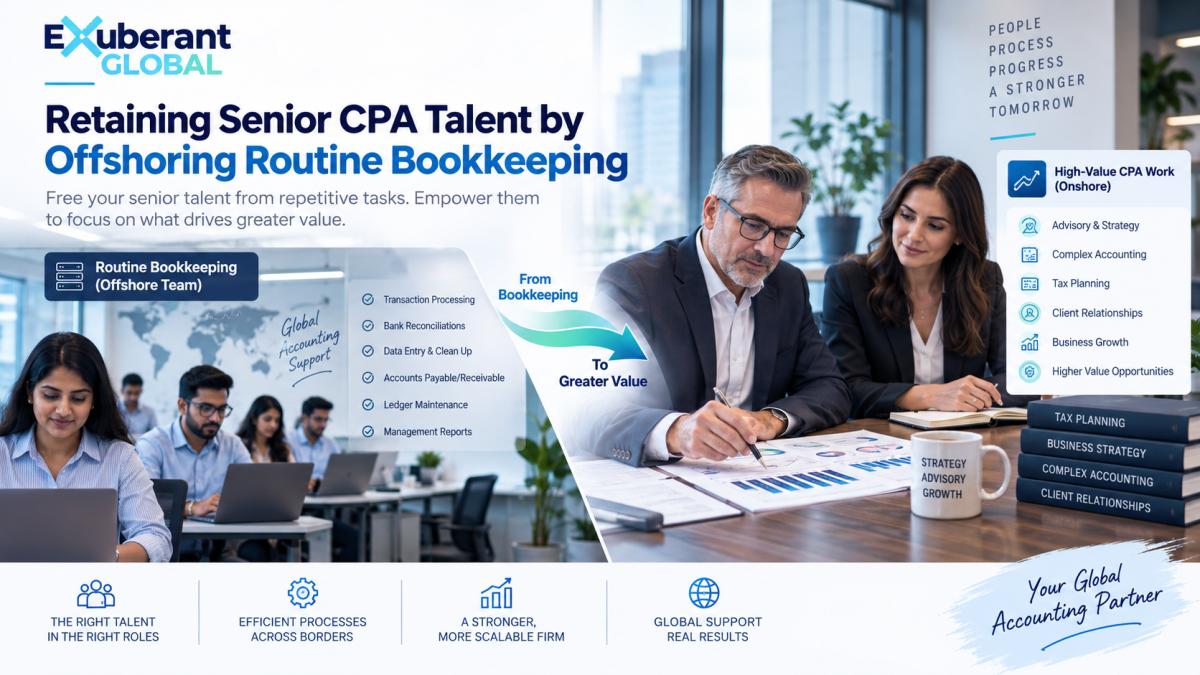
The Anatomy of the Accounting Talent Drain
Ask ten managing partners what keeps them up at night, and nine will give you the same answer: finding and keeping competent senior accountants. The accounting profession is facing a structural demographic crisis. According to data published by the AICPA in their Trends reports, the number of candidates taking the CPA exam has dropped sharply over the past decade, falling by more than thirty percent from peak years. Baby boomer partners are retiring rapidly, and the pipeline of university accounting graduates just isn't keeping up.
Yet, when you look at why mid-career seniors—those essential three-to-seven-year professionals who keep a firm running—are walking away, money is rarely the main issue. The real problem is operational burnout caused by an inverted workflow pyramid.
In a well-run firm, entry-level staff handle the grunt work like source docs, bank reconciliations, and routine ledger entry. Seniors review that work, tackle technical questions, talk to clients, and handle complex filings. Partners review and sell. But because entry-level domestic talent is practically impossible to find—or comes with an unsustainable price tag—firms have accidentally flipped this model on its head. The work has crept upward. Senior accountants making $110,000 to $130,000 a year are suddenly spending twenty hours a week fixing uncategorized transactions in QuickBooks Online, hunting down missing receipts, manually matching Stripe fees, and sorting through messy 1099s.
It is death by a thousand paper cuts. Talented professionals don't spend five years passing brutal exams and learning complex tax codes just to act as glorified data-entry clerks. When your senior staff feel like high-priced manual laborers rather than trusted advisors, they burn out, check out, and eventually leave for industry or competing firms offering a better lifestyle. Fixing this shortage doesn't mean doubling your recruiting budget for scarce local talent. It means protecting your existing seniors by getting low-leverage compliance and data cleanup off their plates completely.
The True Cost of Burdening Seniors with Low-Leverage Tasks
When firm owners check their margins, they usually miss the hidden tax of downward task delegation. This happens when high-value earners routinely do low-value work simply because it feels faster than explaining it. Let's look at the actual math.
Take an experienced senior accountant billed out at $175 to $225 an hour. If that person spends just fifteen hours a week categorizing transactions, clearing bank feeds, reconciling monthly statements, and running payroll, your firm throws away nearly $3,000 a week in potential advisory revenue. Over an eleven-month year, that's more than $130,000 in lost gross margin per senior employee.
Even worse than the lost billing is the capacity ceiling it puts on your entire practice. You can't take on new advisory retainers, launch fractional CFO services, or grow your corporate tax practice when your team is drowning in quarterly book clean-up. Your senior staff become the ultimate bottleneck—not because they aren't smart, but because their calendars are hijacked by routine data entry.
Worse still, when senior accountants spend all their mental energy on manual mechanics, their focus during final reviews takes a hit. Fatigue causes missed tax deductions, overlooked errors, and late filings. Keeping routine bookkeeping pinned to domestic seniors destroys margins, caps revenue, and drives turnover all at once.
The Strategic Pivot: Offshoring Routine Bookkeeping to Protect Local Talent
The answer isn't hiring more expensive domestic entry-level staff who will demand total remote flexibility and require 18 months of training before bolting for a corporate job. The real fix is bringing on dedicated offshore bookkeeping professionals to handle the repetitive legwork before files ever reach your domestic seniors.
Through specialized outsourced bookkeeping services, firms can set up an operational layer that cleans, categorizes, reconciles, and standardizes client ledgers on a regular schedule. This isn't about cutting corners with random gig workers. It's about building a reliable, disciplined delivery engine.
When you choose to hire a dedicated offshore bookkeeper through an established partner, you add a qualified, English-proficient accounting specialist straight into your workflow. That bookkeeper works inside your cloud software—whether it's QuickBooks Online, Xero, Karbon, or Thomson Reuters—following your exact SOPs. By the time your domestic senior opens the file, the bank reconciliations are balanced, receipts are linked to transactions, and questions are neatly documented in a query log.
Suddenly, your senior CPA’s job changes. They aren't doing the dirty work anymore; they are reviewing a clean, standardized package. Their focus shifts from rote entry to high-level analysis, tax strategy, and client advisory. That single shift transforms their day-to-day from frustrating grind to actual professional practice.
| Operational Factor | Traditional In-House Burden | With Offshore Bookkeeping Delegation |
|---|---|---|
| Senior CPA Time on Data Entry & Recs | 15–20 hours / week | Under 2 hours / week |
| Time Spent on Advisory & Tax Strategy | Under 5 hours / week | 18–25 hours / week |
| Senior Staff Burnout Risk | Extremely High | Significantly Reduced |
| Client Turnaround Speed | 3–4 weeks post month-end | 5–7 business days |
| Annual Cost of Delivery Team | $65,000–$85,000 (Domestic junior) | 60–70% lower overall overhead |
Transforming Seniors into Managers: The Career Path Advantage
One quiet driver of senior accountant turnover is a lack of real career growth. In many traditional firms, advancement feels like a joke: you grind through five years of compliance work, and your reward is just a bigger pile of the exact same compliance work, plus a tiny raise and higher billing targets.
When a firm owner decides to build a dedicated offshore team, the senior accountant’s career path suddenly opens up. Instead of staying stuck as an individual contributor buried in spreadsheets, they become pod leaders or engagement managers. They get real leadership experience without having to quit your firm to find it.
Under this setup, your senior accountant gets assigned one to three dedicated offshore specialists who handle routine reconciliations, monthly adjustments, and initial schedule prep. The senior acts as the quality gatekeeper and the main bridge to the client. This brings three massive benefits:
- Empowerment and Autonomy: Seniors build leadership and delegation skills early, preparing them naturally for partner or director tracks.
- Intellectual Satisfaction: Instead of mindlessly clicking matching rules, they analyze balance sheets, review cash flow forecasts, find tax-saving opportunities, and advise business owners.
- Drastic Reduction in Overtime: During crunches like month-end or quarter-end, the offshore team grinds through prep across time zones. Seniors log in to find clean drafts ready for a final sign-off, saving their evenings and weekends.
Present this structure to a talented senior during their review, and you aren't just offering a paycheck—you're offering a sustainable career that actually respects their education and ambitions.
Eliminating the Pre-Tax Season Scramble
Every CPA knows the January dread: clients dumping a year's worth of messy receipts, broken recs, and mismatched bank feeds onto your desk, then demanding immediate answers about their tax liability. Domestic seniors spend the first two months of the year playing emergency bookkeeper instead of tax expert.
By integrating systematic outsourced accounting services and proactive year-end accounting and closing support, you can wipe out this seasonal bottleneck. Dedicated offshore accountants can continuously close client books through Q3 and Q4. When January hits, the ledgers are clean, fixed assets are updated, and trial balances are locked.
That clean slate changes tax season entirely. With books consistently balanced all year, shifting into outsourced tax preparation and domestic senior review becomes seamless. Domestic CPAs can focus strictly on technical elections, passive loss limits, state nexus issues, and tax planning. Instead of surviving 80-hour workweeks fueled by bad data, your senior team gets a manageable, organized tax season—the single best way to keep good people around for the long haul.
Overcoming Internal Hesitations: What About Quality, Data Security, and Client Buy-In?
Firm owners who haven't tried outsourcing usually worry about three things: quality control, security, and client pushback. These concerns make sense, but they usually come from outdated ideas about how modern offshore teams actually operate.
1. The Quality and Competency Question
Many partners worry offshore teams won't understand US GAAP or IRS guidelines found on irs.gov. This usually happens when firms mix up cheap freelance marketplaces with dedicated offshore staffing agencies. Real outsourcing providers hire credentialed accountants—many with commerce degrees, Chartered Accountant (CA) titles, or ACCA credentials—who go through rigorous training specifically on US, Canadian, UK, or Australian tax frameworks.
Give them clear SOPs and checklists, and the consistency of an offshore bookkeeper whose only job is clean reconciliation will often beat out an overworked domestic senior rushing through data entry between phone calls.
2. Data Security and Regulatory Compliance
Security is non-negotiable. Modern offshore operations meet top international data standards. Professional firms work inside secure, SOC 2-compliant environments with multi-factor authentication, enterprise VPNs, and zero-local-storage rules. Team members work directly in your cloud platforms or virtual machines without downloading client files to local drives. With careful permission settings, you keep total administrative control over client data at all times.
3. The Client Transparency Reality
Partners often ask: "What do I tell my long-time clients?" The truth is simple: clients care about results, speed, and direct access to your brain. They don't care who reconciled their credit card at midnight; they care that their numbers are accurate, on time, and interpreted by their trusted CPA.
Positioning offshore delegation as an upgrade is an easy sell. Tell your clients honestly: "To give you the highest level of strategic attention, our firm utilizes a dedicated back-office delivery team to keep your daily books immaculate, freeing our senior CPAs to focus exclusively on your growth, tax strategy, and forward-looking planning." Clients won't complain—they'll love it.
A 4-Step Practical Roadmap for Firm Owners Ready to Delegate
Moving from an internal bottleneck to a scalable, blended model doesn't happen by accident. You need a deliberate, step-by-step plan to protect your staff and set up smooth workflows.
Step 1: Audit and Isolate Low-Leverage Bookkeeping Tasks
Have your senior accountants track their time closely for two weeks. Find every task that doesn't require client calls or deep technical analysis. This list will definitely include bank recs, AP matching, routine transaction coding, sales tax reports, and payroll journal entries. This forms the baseline job description for your offshore hire.
Step 2: Document Repeatable SOPs
Don't expect an offshore professional to guess your firm's quirks. Make quick, practical SOPs. A simple Loom or Vidyard screen recording walking through a monthly reconciliation is often ten times better than a thirty-page manual. Show them where files live, how to flag problems, and what checklists to finish before handing work over.
Step 3: Pair One Dedicated Offshore Specialist with One Senior CPA
Avoid throwing work into a general pool. Successful firms pair a dedicated person directly with a specific senior CPA. This builds trust, communication, and rhythm. The senior learns how to delegate, and the offshore team member gets to know that senior's exact client list, preferences, and expectations.
Step 4: Shift Your Senior’s KPIs from Input to Output
Finally, change how you evaluate your senior accountants. If your firm measures success purely by billable hours logged at a desk, your people will naturally hoard low-value work to hit their numbers. Shift their metrics to portfolio realization, turnaround speed, client satisfaction, and advisory project growth. Reward them for delegating well and multiplying their impact.
Building an Enduring Firm in an Era of Scarcity
The accounting talent crunch isn't a temporary storm you can just wait out. It's a permanent shift. The firms that survive and stay profitable won't be the ones offering massive signing bonuses for scarce local talent. They'll be the ones that redesign how they operate from the ground up.
By intentionally separating routine bookkeeping from advisory and analytical work, you solve your two biggest problems at once: you get immediate operational capacity at a predictable cost, and you build a workplace culture where senior accountants can actually thrive, move up, and stick around.
If you're ready to take the weight of daily bookkeeping off your senior staff and scale your practice efficiently, see how partnering with Exuberant Global can change your operations. Take the first step toward safeguarding your firm's future and contact our team today for a confidential consultation.
Ready to Scale Your Business?
Connect with our experts to learn how our outsourcing solutions can drive growth.
BOOK A DISCOVERY CALL