 : +1 308-7304-232
 : +44 (744)-139-7094
 : +61 4 8080-3582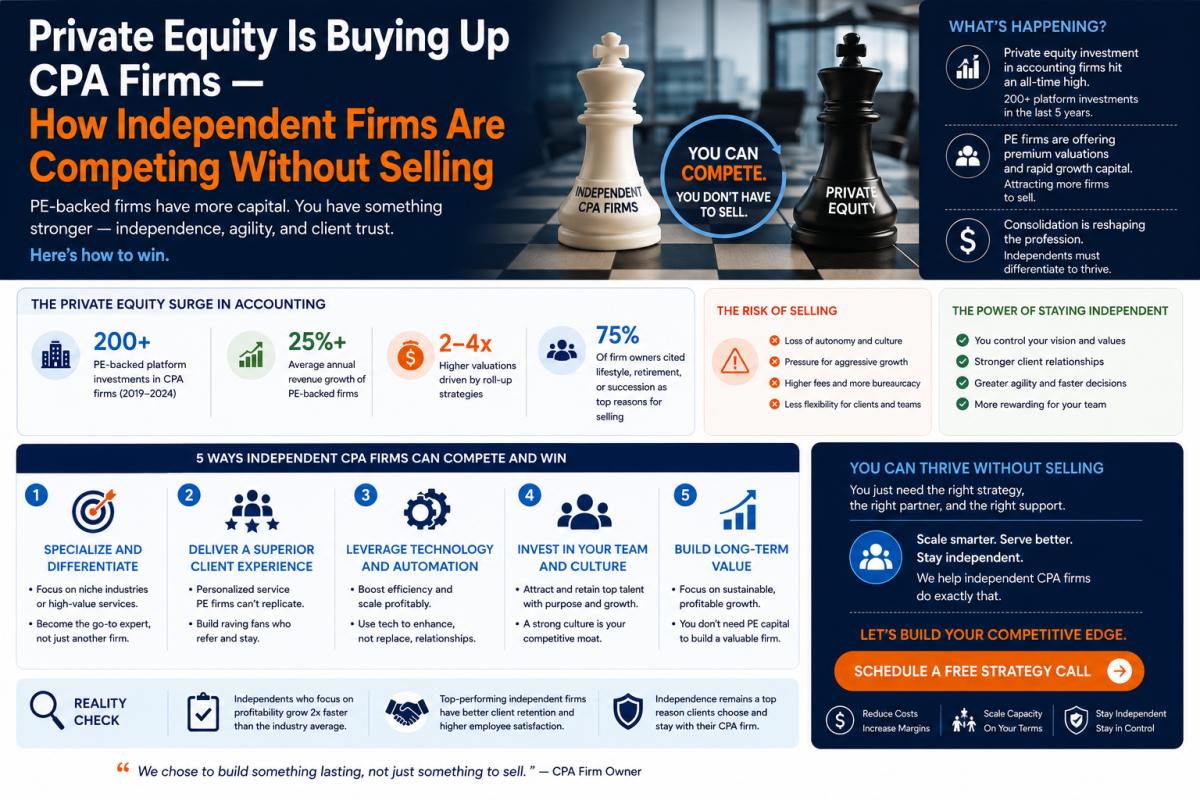
If you've felt like your firm is suddenly competing against organizations with far deeper pockets than a regional CPA practice should have, you're not imagining it. Private equity has moved into accounting at a pace that would have seemed unlikely five years ago, and it's quietly reshaping who your firm competes with for talent, for clients, and even for the smaller firms you might have once considered acquiring yourself. You don't have to be thinking about a sale for this trend to matter to you. It's already changing the ground underneath every independent firm, whether they're paying attention to it or not.
What's Actually Happening
Private equity's entry into accounting relies on a specific legal workaround called an Alternative Practice Structure, or APS. State licensing law requires audit and attest work to stay under CPA ownership, so PE-backed deals split a firm in two: the attest practice stays CPA-owned on paper, while the much larger non-attest side — tax, advisory, bookkeeping, and consulting — gets sold off to a PE-backed platform. It's a workaround, but a legal and increasingly well-worn one, and it's what's allowed billions of dollars in outside capital to flow into a profession that was almost entirely partner-owned a decade ago.
What's striking isn't just that this is happening — it's how fast it's accelerating. Deal volume in the accounting sector rose 26% year-over-year in 2025 and has kept climbing into 2026, according to investment banking firm Capstone Partners. Financial acquirers now account for roughly 54% of total deal volume in the sector. That's not a niche trend anymore. More than half of all accounting firm transactions today involve a PE-backed buyer rather than a traditional strategic acquirer, and that shift happened in just a few years.
The Scale of It
Several names you'd recognize from any Top 100 list are now PE-backed platforms: Citrin Cooperman, EisnerAmper, Baker Tilly, Grant Thornton US, Crowe US, and Aprio. Citrin Cooperman's sale from one PE sponsor, New Mountain Capital, to another, Blackstone, in early 2025, reportedly around a $2 billion valuation, was the first sponsor-to-sponsor exit among the top 30 US firms. That detail matters more than it might seem — it means PE money now sees a real path to cashing out of these platforms, not just pouring money into them. This isn't a speculative bubble anymore. It's a functioning market with buyers on both ends.
Why Private Equity Wants CPA Firms in the First Place
The appeal isn't complicated once you look at what a CPA firm actually is as an asset. Annual tax returnseem—itkeeping retainers, quarterly advisory work — this is about as sticky and predictable as revenue gets. Clients don't churn out of their accountant the way they churn out of a subscription box. That predictability is exactly what private equity pays a premium for. Platform-level deals have been valued at 2–4x revenue, with the largest transactions exceeding $1 billion in enterprise value, and individual partners at acquired firms often walk away with a liquidity event equivalent to 10 or 15 years of traditional partnership draws, paid out essentially at once. It's easy to see why that offer is tempting, even for firms that never thought they'd sell.
Who's Actually Buying
The buyer landscape is a lot wider than the handful of mega-deals that make headlines, and it's worth knowing which type of buyer you're actually likely to encounter, because it's usually not the one you'd guess from the news.
Mega-platforms
The largest, most visible deals — Citrin Cooperman, EisnerAmper, Baker Tilly, and Grant Thornton US — are each backed by a major PE sponsor and operating at a national scale. These make the news, but they're not who most independent firms actually deal with.
Lower middle market (LMM) platforms
Purpose-built roll-up platforms targeting smaller, sub-$100M enterprise value deals. This is where most independent firms actually get approached — far more often than by a household-name mega-platform.
Strategic CPA-firm-on-CPA-firm buyers
Traditional firms are acquiring smaller practices directly, with no PE backing involved. Still a meaningful share of deal volume, and the closest thing left to the "old normal" acquisition path.
The deal structures themselves also look different depending on size. For solo and small firms under $500,000 in annual revenue, valuations typically run 0.9–1.3x annual revenue. In lower middle-market deals, cash at close usually covers 60–80% of the purchase price, with the rest tied up in rollover equity and multi-year earnouts based on client retention. So even the firms that do sell rarely walk away with one clean check. A meaningful chunk of what they're owed depends on how the business performs aftearn-outseal closes—which is worth knowing if you've ever assumed selling means a tidy immediate exit.
What This Means If You Have No Interest in Selling
Here's where this stops being a story about someone else's decision and starts being your problem too. PE-backed platforms can invest in technology infrastructure at a scale an independent firm simply can't match out of its own balance sheet. They can dangle compensation packages — signing bonuses, equity-like incentives, a career path spanning a dozen offices — that put real pressure on independent firms already fighting the broader accounting talent shortage for every hire. And they can expand into new markets and service lines faster than an organically growing partnership ever could, simply because they're not waiting on retained earnings to fund it.
For firms with zero interest in selling — whether that's a genuine belief in staying independent, a different vision for client service, or simply not being at a size where a PE deal makes sense — this creates real competitive heat without any of the liquidity upside. You're not getting a payout. You're just getting a tougher market.
How Independent Firms Are Actually Competing
The firms navigating this well aren't trying to out-spend platforms with hundreds of millions in outside capital behind them — that's not a fight an independent firm wins. Instead, they're competing on a different axis entirely: staying lean enough to be genuinely fast and personal while finding a way to still match the capacity and service breadth that PE-backed competitors can offer.
| PE-Backed Platform Approach | Independent Firm + Offshore Approach |
|---|---|
| Outside capital funds rapid local hiring and roll-up acquisitions | Offshore staffing adds capacity at 50–65% lower cost, funded from your own operating cash flow |
| Standardized service delivery spread across dozens of acquired offices | Retains genuinely local, partner-led client relationships while scaling back-office capacity |
| Large technology budgets spread thin across the whole platform | Cost savings from offshore staffing get reinvested directly into your own tech stack |
| Partners trade equity and control for liquidity and capital | Partners keep full ownership and decision-making, with no outside investor in the room |
In practice, this usually looks like building an offshore or hybrid accounting team to absorb the bookkeeping, tax preparation, and compliance-heavy work that would otherwise mean expensive local hiring. That frees up local partners and senior staff for the client relationships and advisory work that PE-backed platforms genuinely struggle to deliver with the same personal touch once they've scaled across dozens of offices — ironically, the thing clients often say they miss most after their old firm gets rolled up into a bigger platform.
Practical Steps for Staying Competitive Without Selling
- Build offshore or hybrid capacity now, before a talent shortage forces a reactive scramble
- Reinvest the resulting cost savings into technology and client-facing advisory capability, not just margin
- Lean into the relationship-driven service model that gets structurally harder for platforms to maintain at scale
- Benchmark your compensation and career-path offerings against what PE-backed firms in your market are advertising
- Consider whether a niche service specialization could differentiate your firm from broader, generalist platform competitors
Frequently Asked Questions
Is private equity actually taking over the entire accounting profession?
Not entirely, but the shift is real — financial acquirers now represent roughly 54% of accounting sector deal volume, and several well-known firms have already converted to PE-backed platforms. The lower middle market, where most independent firms operate, still has plenty of independently owned practices, but the competitive dynamics around them have clearly shifted.
Do I have to sell to compete with PE-backed platforms?
No. Plenty of firms are choosing to stay independent and build capacity through offshore staffing instead, which lets them compete on service breadth and cost efficiency without giving up ownership or control.
Why does offshore staffing keep coming up in a story about PE consolidation?
Because PE-backed platforms compete partly on capacity and technology investment funded by outside capital. Offshore staffing gives an independent firm a way to build comparable capacity funded out of its own operating margins, without needing to bring in an outside investor to do it.
Is this trend expected to keep going?
Based on current reporting, deal volume has kept rising through 2026 with no clear signs of slowing, though market conditions can shift and past activity isn't a guarantee of what happens next.
Key takeaways: AccountingMA volume is up 26% year-over-year, with PE-backed buyers now behind 54% of deals. Most independent firms will encounter this pressure through lower middle-market platforms, not mega-deals. The competitive response that's actually working isn't matching PE dollar-for-dollar—it's building capacity through offshore staffing, funded from your own margins, while staying independent.
Final Thoughts
Private equity isn't going away from accounting, and independollar-for-dollar—it'sin order to keep competing. The firms handling this well are the ones building real operational capacity — enough to genuinely compete on service breadth and turnaround time — without trading away the ownership and client relationships that made them want to run an independent practice in the first place. Offshore staffing has become one of the most direct ways to do that: it funds the capacity gap out of your own margins instead of someone else's capital, on your own terms.
If your firm wants to build that kind of capacity without selling equity or control, see how Build Your Team works and what a dedicated offshore team could look like for your practice.
Ready to Scale Your Business?
Connect with our experts to learn how our outsourcing solutions can drive growth.
BOOK A DISCOVERY CALL