 : +1 308-7304-232
 : +44 (744)-139-7094
 : +61 4 8080-3582
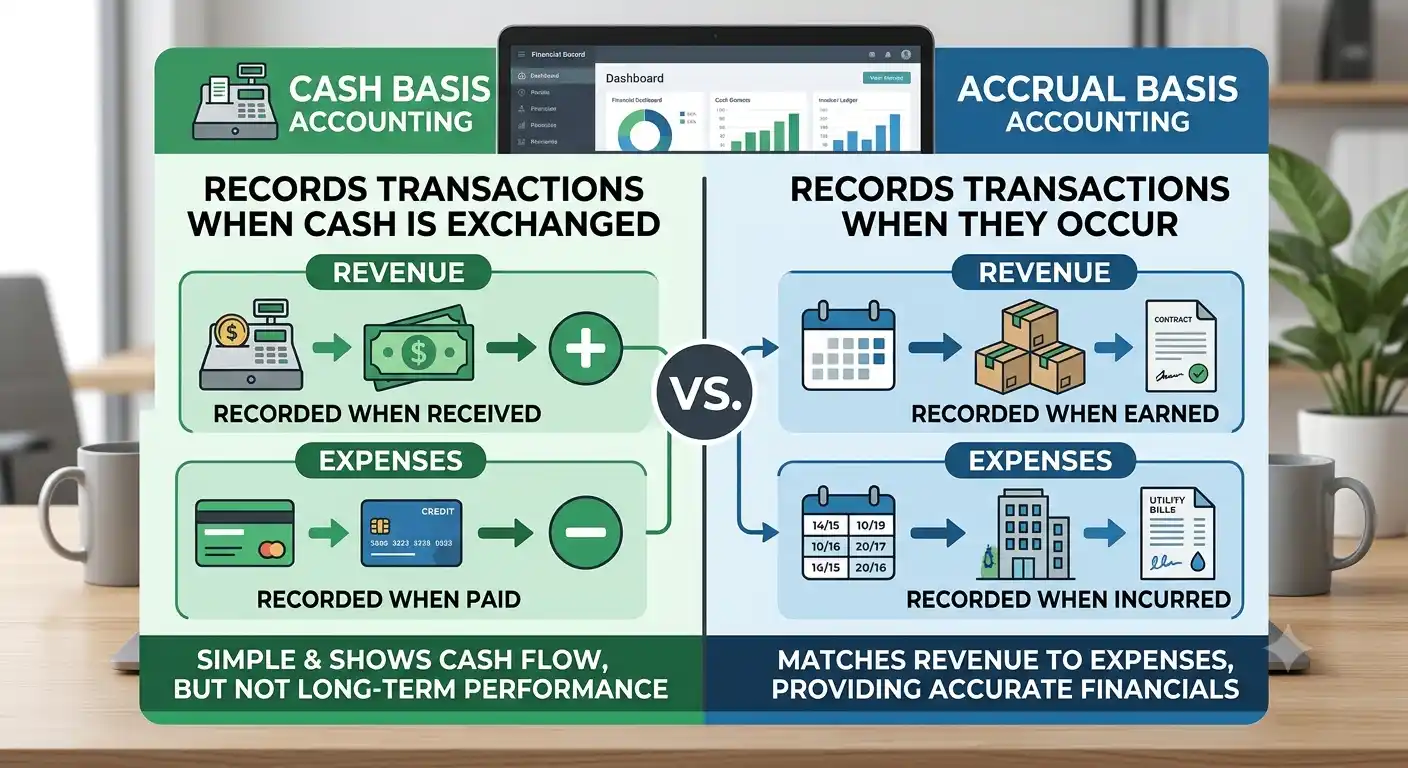
Your choice of accounting method determines how your financial position is measured, when your tax is due, how your company is viewed by outsiders and how you go about budgeting and planning for future growth.
The fundamental difference between the two systems is down to one financial aspect actually: timing. It's the precise point at which an economic event (whether that's a sale to a customer or a payment to a supplier) is recognised and formally recorded in your books.
Foundational Core: The Time Horizon of Business Transactions
To understand both systems you have to appreciate the difference between an economic event and a monetary liquidation.
An economic event is the transfer of value. A software company delivers code to a customer, a consultant runs a strategy session, a manufacturer ships a crate of physical goods to a distributor. In each case work has been done, the responsibility has been passed on and value has moved from one party to another.
A monetary liquidation is when actual money (via cash, credit card, ACH, wire check etc) actually moves into or out of a bank account.
The fundamental difference between cash and accrual accounting is simply which of the two of these you use as the basis for your financial truth.
Cash Accounting: The Mirror of the Bank Ledger
Core Definition and Mechanics
Cash accounting (or cash basis accounting) is designed to be straightforward. A transaction is recognised and recorded under this method if and only if cash has actually changed hands (either physically or electronically). Your accounting software or your paper journal is effectively just a mirror image of your bank statement at any given time.
Revenue recognition: revenue is recognised on the exact calendar day that the cash is actually received from the customer. If you do comprehensive consulting work throughout October, issue an invoice in November and the customer pays you in January then the cash method says that there was no revenue in October or November. The entire transaction is recorded as revenue in January.
Expense recognition: expenses are recognised on the day the money leaves your business account. If you buy an annual insurance policy in December the full premium is deducted from your profit in December even though that policy will cover you for the next 12 months.
Strategic Benefits of the Cash Method
The persistent popularity of cash accounting among solo entrepreneurs, micro-businesses, and early-stage startups stems from three primary operational advantages:
Ultimate operational simplicity: as the system only tracks cash movements it removes the entire administrative burden of managing a multitude of sub ledgers. You don't need to build out the full range of workflows for tracking uncollected customer invoices or managing a pipeline of outstanding vendor bills. That in turn reduces the need for a large team of bookkeepers and eliminates the need for a complex ERP system.
Perfect cash flow visibility. The balance sheet under a cash basis system will tell you exactly how much spendable capital you have on hand at that very moment. There's no guessing as to whether the assets you've reported are locked up in a client who's paying late or are in some non-liquid form. If your books say you have $50k, you have $50k in spendable capital in your account.
Inherent tax optimisation and liability control. For a small business the cash basis is in many ways a natural form of protection against early tax liability. You are only legally liable to pay income tax on the cash that you actually receive. If a client owes you $100k and you're just waiting for them to pay that, you're not liable to pay a cent of tax on that $100k until it actually comes into your bank account. You can also use the cash basis to manage your year end tax bracket by accelerating your necessary expenses into December (e.g. prepaying your rent, buying your office equipment etc) or delaying your customer invoices until January to defer the revenue into the next year.
Destructive Drawbacks of the Cash Method
Despite its comforting clarity, cash accounting suffers from deep systemic blindness that makes it completely unviable for large-scale operations or complex business models:
Violent short term profit distortions. The cash method completely fails to link effort to reward. Suppose your company spends $20k in May on raw inventory to do a huge project and the client doesn't pay you until September. Your monthly P&Ls are going to show a massive loss in May and a massive windfall in September. It's impossible to judge your month on month operational performance.
The illusion of abundance. A cash ledger can very easily create the illusion of financial health in a business. The company may have $80k sitting in its checking account which would be a very healthy looking figure. It may well be that the company has $95k of vendor bills due the following week though and the cash ledger will completely mask that impending crisis of insolvency until the cash actually disappears.
Complete omission of key financial assets and liabilities. By not including future obligations you're effectively omitting two major balance sheet line items under cash accounting; Accounts Receivable and Accounts Payable. You're running your business with a huge data blindspot.
Accrual Accounting: The structural architecture of modern commerce
Core Definition and Mechanics
Accrual accounting is based on the fundamental principles of GAAP and IFRS. It's not about just tracking the bank balance. It's about recording the economic reality as it happens. Under the accrual method a transaction is recorded at the point of obligation, the point of service delivery or the point of product delivery.
This is all down to the Matching Principle. The Matching Principle states that all the revenue earned in an accounting period must be matched against the exact expenses that were incurred to generate that revenue.
Revenue recognition: revenue is recognised when it is earned and realisable regardless of when the payment is actually cleared. When you ship the goods or complete a contracted milestone and issue an invoice you will debit your accounts receivable and credit your revenue at the same time. The sale is in your performance metrics straight away.
Expense recognition: expenses are recognised as they are incurred. If your staff work hard in the final two weeks of December and their pay is actually issued in the form of a cheque on the 5th of January then those wage expenses must be recorded on your December income statement. They are an obligation of the year in which the work was performed.
Strategic Benefits of the Accrual Method
Accrual accounting is the universal language of institutional finance because it delivers unparalleled clarity for long-term management:
True representation of long term profitability comes from the elimination of the noise of irregular payment timing. The accrual financial statements will show you the real underlying economic engine of your business. You can see at a glance whether your core pricing, your labour intensity and your operating costs are in fact fundamentally profitable over the long term.
Advanced budgetary forecasting and planning: as your ledger is constantly tracking your Accounts Receivable (what your customers owe you) and your Accounts Payable (what you owe your vendors), you can build predictive cash flow forecasts. You can see months in advance whether you're going to be in a position of financial deficit or surplus and that gives you the headroom to make a pivot or to go and get credit.
Universal Capital and Institutional Readiness: If at any point in your business life you need an open line of credit from a commercial bank, you need venture capital or you're looking for an institutional buyer on exit, cash basis statements will be automatically rejected. The banks and investors will want to see accrual basis statements as they need to assess your long term recurring revenue model, your contract backlog and your structural liabilities. The cash basis statements hide all of that behind the erratic cash collection cycle.
Destructive Drawbacks of the Accrual Method
While intellectually rigorous, the accrual framework introduces sharp operational friction points that can threaten an unwary business:
The Deadly Cash Flow Paradox (Phantom Profits): Under the accrual method of accounting, a business can be looking absolutely fantastic on its P&L statement and yet be completely broke in the real world. If you've landed three big contracts and you've got $500k of revenue on your books for the quarter, your P&L will be absolutely thrilled. The problem is if those customers are all on Net-60 terms then you may well have absolutely no cash in the bank to pay your rent, your staff, your software etc. This is the 'dying of success' phenomenon where you go from being in a very good position to being in a very bad one very quickly as your accounts receivable grow massively and your actual cash runs out completely.
Complex admin overhead. To actually run an accrual system you need double entry accounting software, you need to be very disciplined about the revenue recognition rules and you need to be constantly reconciling your subsidiary ledgers. The business owner has to understand the concepts of prepaid expenses (paying for something before you've used it) and deferred revenue (collecting the cash before you've actually done the work). You pretty much always end up having to employ a professional bookkeeper or a certified accountant to do this.
Premature tax penalties: as income is recorded at the time of billing you can quite easily end up with thousands of dollars of corporate and personal income tax owing at the end of the fiscal year on massive invoices which your customers have not in fact paid. If a major customer defaults on an invoice after your tax return has been filed you are then in the position of having to go through the intricacies of the bad debt write-off process in order to claw back those tax assets which have been overpaid.
Side-by-Side Architectural Blueprint
To easily review how these methods diverge across every operational touchpoint, consider the following comprehensive breakdown:
Structural Dimension
| Structural Dimension | Cash-Basis Accounting | Accrual-Basis Accounting |
| Primary Focus | Absolute tracking of cash solvency and immediate liquidity. | Tracking long-term economic activity and obligations. |
| Income Timing | When the customer's payment clears the bank account. | When the invoice is issued or the work is delivered. |
| Expense Timing | When the check is written or the electronic transfer clears. | When the bill is received or the resource is consumed. |
| Core Balance Sheet Items | Limited. Excludes future customer debts and vendor liabilities. | Comprehensive. Actively features Accounts Receivable and Accounts Payable. |
| Compliance Alignment | Rejects GAAP and IFRS framework guidelines completely. | Fully aligned with standard GAAP and IFRS regulatory rules. |
| Tax Invoicing Exposure | Zero. Tax is paid exclusively on realized, spendable income. | High. Tax can be due on uncollected invoices and theoretical profits. |
| Operational Workflow | Simple single-entry monitoring or basic ledger matching. | Rigorous double-entry bookkeeping with adjusting journals. |
| Long-Term Forecasting | Reactive. Heavily restricted by a lack of forward-looking ledger data. | Proactive. Excellent for predicting multi-month cash runways. |
Real world case study: the danger of the invoicing gap
To make these concepts concrete in an actual scenario, let's follow the financial trajectory of a premium digital marketing agency over a two month winter period.
The Scenario
In Dec 2026 the agency does a full brand refresh for an enterprise client.
- The total agreed contract value is $50k.
- To finish the project the agency employs specialist freelancers at a cost of $15k.
- Project successfully wrapped and handed over in full on 25th December and invoice generated straight away.
- The agency pay their freelancers out in December (in full) to keep the relationship good.
- The enterprise client, in accordance with their corporate cash policies, are holding off on payment until January 2027.
Let's look at exactly how that same economic timeline would appear under both accounting treatments.
The Cash Ledger View
As no cash came from the client in December the agency can't recognise any income. They did however pay out cash to their freelancers.
- December P&L: $0 (Revenue) -15,000) Net Loss
- January P&L: $50,000 (Revenue) - $0 (Expenses) = $50,000 Net Profit
Strategic impact: the cash basis statements tell a completely different story. To an outside observer looking at the December statements you'd think the agency is in terminal decline, bleeding capital and structurally unsound. Looking at the January statements you'd think it's an absolutely efficient business running on a 100% profit margin. Neither of those statements in any way reflects the actual state of the business.
The Accrual Ledger View
The revenue is earned in December as the brand project was fully complete and delivered in that month. On a strict application of the matching principle the associated freelance costs to create that brand work are also in December.
December P&L: $50,000 (Revenue) - $15,000 (Expenses) = $35,000 Net Profit
January P&L: $0 (Revenue) - $0 (Expenses) = $0 Net Profit
Strategic impact: the accrual statement cuts right through the timing noise. It tells the business owner the real story: the campaign was a huge success and produced a genuine 70% margin in the month that the operational spend was incurred. In January when the $50k cash comes in, the accountant just does the balance sheet update (clears the $50k from AR and puts the $50k into cash). No new profit is recognised in January as the economic value was already there.
Regulatory Frameworks: The IRS and the boundaries of statutory compliance
You can't just pick your accounting method on the basis of what you personally like. The financial regulators (most notably the IRS in the US) have very specific statutory rules as to when a business is required to give up the simplicity of the cash basis and move to the more rigorous requirements of accrual accounting.
The Gross Receipts Test
The principal regulatory threshold is based on the volume of a business's annual revenue as determined by the IRS Gross Receipts Test.
The Safe Harbor threshold: under the current tax code small businesses are generally entitled to use the cash method of accounting if their average annual gross receipts over the three preceding tax years do not exceed a certain inflation adjusted ceiling. For the most recent tax years that figure is somewhere around $30m.
The Accrual Mandate: as soon as a growing company's three year average gross receipts cross the $30m line the cash method is no longer permitted. The business has to formally switch to the accrual method for its corporate tax accounting.
The Inventory Rule and Exceptions
Historically any business with a physical inventory of goods on hand (i.e. a retailer, an e-commerce business, a wholesale distributor etc) was absolutely prohibited from using cash accounting. The idea being that they wouldn't be able to write off the cost of the inventory as an expense immediately as they'd have the goods sitting on the shelves.
Modern tax updates have brought considerable benefit to smaller operations. If your business is comfortably below the $30m gross receipts test you can elect to treat your physical inventory as non-incidental materials and supplies or you can simply track your tax books in line with your standard financial software books. This enables the smaller operator to continue to use cash basis tax reporting if that is in their best interest in terms of cash flow.
The Hybrid Compromise: Finding Middle Ground
For a whole lot of business owners in the middle ground (too big to be just cash accounting and too small to justify the full rigour of an accrual system) the Hybrid Accounting method is the answer.
A hybrid system enables an enterprise to blend elements of both approaches, as long as the resulting system is applied in a consistent manner from year to year and doesn't in any way distort your financial reality for the purposes of tax avoidance.
A Typical Small Business Hybrid Blueprint:
Accrual basis for sales and inventory. The business will of course track its core sales, its customer accounts receivable and its physical product inventory on an accrual basis. That way the major movements in product and the credit sales are properly captured and the cost of goods sold will be matched to the seasonal peaks in consumer demand.
Cash basis for overhead expenses: the same business records its basic admin overheads (i.e. the monthly office rent, software subscriptions, insurance premiums and utility bills) on a cash basis. These are fairly static, predictable monthly expenses so recording them as they hit the bank statements doesn't have any impact on the long term financial picture.
To execute a clean accounting transition, your team should prioritize the following phases:
Phase 1: Isolate and Quantify Your Timing Gaps
Before adjusting your system settings, look back at your prior cash ledger and compile three critical data lists:
- Uncollected Income: take every invoice you've sent to a customer where the work was completed prior to the cut-off date and the money hasn't yet come in. That's your starting point for Accounts Receivable.
- Unpaid Obligations: Take all of your bills, invoices and any other recurring charge you've received from a vendor for goods and/or services you've used prior to the cut-off date and which you have not yet paid. That's your initial Accounts Payable.
- Prepaid Assets: identify any large lump sum payments made for future benefits (a 12 month software licence paid in full upfront as an example) so that they can be apportioned over the months in which they actually benefit the business.
Phase 2: Execute Conversion Adjustments in Your Bookkeeping System
Once these lists have been validated your accountant will then enter the appropriate special adjusting journal entries to bring your ledger accounts up to date.
- To recognise uncollected income they'll credit your retained earnings and debit your accounts receivable.
- To identify the unpaid liabilities they will debit the appropriate historical expense accounts and credit your Accounts Payable.
- Physical stock on your shelves will be removed from the expense categories and will be shown on the balance sheet as an inventory asset.
Phase 3: Formally Register the Change with Tax Authorities
Changing how you run your internal management reports is a purely internal business decision. Changing how you report your income to the Government is a legal event. In the US a business has to formally apply for a change in accounting method by completing IRS Form 3115 (Application for Change in Accounting Method). This form must be prepared by a qualified CPA and submitted in the tax year in which the change is to take effect. This ensures that your change is compliant with the relevant tax rules and that you don't end up underpaying tax.
Conclusion: Balancing Simple Tracking with Strategic Control
Choosing between cash and accrual accounting isn't about working out which is the one absolutely correct answer. It's about picking the right method for your business at the current stage of its operation, in light of your regulatory requirements and your business objectives.
If your main objective today is to keep the admin to a minimum, to manage your absolute day to day survival liquidity and to keep tax prep as simple as possible then cash accounting is absolutely the right tool for you at your current scale.
Ready to Scale Your Business?
Connect with our experts to learn how our outsourcing solutions can drive growth.
BOOK A DISCOVERY CALL